I raced the shortened Seeley Classic "long" race, even though I couldn't find a picture on SkinnySki to show for it. It was a frigid morning race start at -9 F. I just registered for the race two days prior, taking my time to decide if I should race the long or the short one. Because I thought I needed a boost in my training and because I didn't want my 30km race at World Masters to be my longest race of the season thus far, I went for the longer one.
I arrived at OO on the late side, as is typical for me. I didn't have time to test kick wax; luckily my Guru Green was kicking fairly well. My skis were fast. I waxed them the night before with Fast Wax LF Teal. I love this wax for hardening the base. Unlike other brands, Fast Wax is super easy to apply and remove. Then I applied a couple more layers for good measure.
This was my longest race of the season so I didn't want to go out too hard. I was skiing with a great group of women: Kim Rudd, Josie Nelson, and Marit Sonnesyn. For about 28 kilometers we all went back and forth. I realized I need to work on the downhills, that is where I repeatedly lost time. Earlier this season I bought a new pair of salomon skis and I'm not able to control them as well as with my older Atomics. My finish placing was 4th woman overall, 51 seconds behind Marit, 1:23 behind Josie, and well... less than 10 minutes behind Caitlin. Even though I was one place out of the money, I accomplished my goal of getting in a really solid training race.

Vakava Team Photo
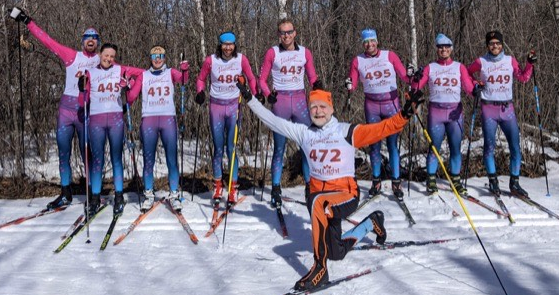
Vakava Racers at the Mora Last Chance Race
Wednesday, January 17, 2018

Sunday, January 14, 2018
Selling My Soul and other Musings
Well, after much debate I did it.
And now I’m a bit more like Erik, who I swear has just about a pair of Salomon boots for every pair of skis he has because none of his boots and bindings are compatible!
So what am I talking about? The plight of the pilot bindings...what else?
Back in high school, 16 years ago, half my life ago, I got my first pair of skate boots and they were pilots- all the rage in the Nordic ski world. It was 2001 afterall and the Olympics were coming to Salt Lake City in a few months. And since then, I’ve been a pilot devotee. I love Salomon boots on my feet (well, not completely, but we’ll say 90% of the time which is bound to happen when spending lots of time in boots) and when I’ve demoed some not-to-be-mentioned other brands, my feet have screamed “get these off me now!”
 |
| My old quiver of skate skis, all with old pilot bindings. From left to right: my rock skis that were my race skis in high school and early college; my race skis (obviously a decade old- the graphics don't lie); my B skis. |
But alas, as the demise of the pilots has been foreshadowed over the past couple years and I’m desiring some new skate skis and some new boots, I have really procrastinated (and those of you who know me know I don’t procrastinate much). I was also kind of waiting for those new carbon Salomon skate skis to come out in my tiny 177 cm size. So when Devin at Finn Sisu finally secured me a pair, I had to decide on bindings. My current black beauty ski boots are 9 years old. Being a pilot devotee, I scoured the websites from every store I know in the Midwest and no one had a single pilot boot in my size. I’m sorry to report for all you other pilot devotees out there...pilots are dead:(
So to not delay the inevitable any longer, I got some Prolink bindings and switched one pair of bindings on another pair of skis. Walking out the door with my first non-pilot skate bindings in half my life felt, well, akin to something like selling my soul!
 |
| Ecstatic about my new carbon skate skis!!! Photo: Devin |
 |
| My first ever NNN bindings. I may be smiling on the outside but on the inside I was crying. Photo: Devin |
A few weeks later, over the holidays, I was out skiing with my brother.
“Sister, what kind of binding are those?” he asked rhetorically. “Sister, wow, you made the big switch!”
Intervals on the busy Elm Creek hamster loop: It just so happened that my first day on snow this winter I decided to do intervals. Now some might say this is not the best plan, but that week I wasn’t motivated to do my intervals running, bounding, or rollerskiing; I was motivated to do them skiing. I also figured that there is no better way to work on ski speed than by skiing fast, so why not do intervals my first time on snow for the season? I did my intervals skating and tried to work on my balance. It was extra difficult because there were some icy patches on the machine made loop and the donut hill. Since it was a weekend there was also lots of people dodging but I got my intervals done and added to my skills of skiing through traffic.
The next week I did intervals again on the hamster loop. This time I did classic intervals. It was the weekend again and very busy. Unlike the week before, being in the classic tracks it became so much more obvious how I passed a lot of people during my intervals and then these same people passed me back up while I was “resting” and skiing slowly. Normally I don’t do intervals in front of so many other people and I was a bit self-conscious of my uneven pacing even though this was quite intentional. I was wondering if these people were wondering why I would ski so fast, blow up, rest, then ski so fast again. Hopefully they caught on that I was doing intervals and not skiing stupid!
 |
| Me skiing at the Nordic Opener at Elm Creek on Dec 9, 2017. It seemed the crowds came in waves and this was a more quiet time. Photo: Bruce Adelsman |
Indoor Running: The Minnesota Distance Running Association (MDRA) sponsors the US Bank Stadium run. This is not a race but a chance to do some indoor running during the winter without dealing with cold temps, darkness, or snow and ice. Check out the website: https://runmdra.org/programs/indoor-stadium-running/
Erik and I decided to do this one night. It was a good experience and a nice way to see the stadium for only $3! The loop is 0.44 miles. It was fairly cool in the stadium so I didn’t sweat too much. Even though I’m not a very good runner, I was still pleased to be passing many people in the “slow lane.” There is also a ramp on the east side of the stadium that can be used for hill repeats if you are interested. Despite the relatively short loop, I kept myself plenty occupied between people watching, looking at everything in the stadium, and trying to get some glimpses of downtown as I ran by the windows. The only downside is running on concrete. Usually MDRA hosts a few runs per months but this year due to the Super Bowl there are no runs in January. There are some February dates and I’m guessing they will sponsor this again next year!
 |
| Erik snapped this photo of my running inside US Bank Stadium. He said it was uber artistic. In case you find it too blurry, that's me running with the football field in the background. |
Thursday, January 4, 2018
Skiing in the Negatives
This past weekend I found myself in Bemidji, MN (aka Burrrmidji) visiting family with lows in the minus twenties and highs in the minus teens. Despite this, I got out to ski everyday.
First, let me start with a couple things I try NOT to do when it’s -20 °F (or maybe even below zero).
Intervals. I prefer to do intervals when it is 10 °F or warmer outside as doing intervals in sub-zero temperatures can really make my lungs burn. Towards the end of December we had a string of days with temperatures around zero and when it happened that the day it warmed up to 12 °F it was logistically difficult for me to drive to machine-made trails, I decided to do my intervals running. While I believe it is best to do intervals in the specific sport you are trying to be best at to maximize efficiency, running intervals should still be good for building the VO2 max.
Long skis. I have done some 3 hour skis at temps around "the doughnut." -20 °F is another story. On a long ski, inevitably there is sweat and those temps below zero cause that sweat to freeze which is obviously not good and can zap all that body heat quickly.
This past weekend, since I was also visiting family, I didn’t feel too bad about skiing for less time and spending more time with family. We (my husband, brother, and I) planned to ski for 1.5 hours and one time almost got to two hours. Locals may say the weather isn’t so bad and take pride in living in the ice box, but these are the same people who leave their cars running when going into the grocery store and ice fish in their heated ice houses. Given the very few people you will actually encounter out on the trail, even this short amount of ski time will make you feel pretty hardy for braving the elements for 1.5 hours!
So what to do when it’s -20 °F out in terms of clothing? It’s all about protecting exposed flesh and appropriate layering. I’m not very versed on skiing at temps these cold so most of this advice comes from trial and error.
It’s important to remember you still sweat when it’s -20 °F, especially if you overdress.
Minimize exposed flesh: My husband and I decided to go for an early morning walk on the lake by my mom’s house. Air temp was -28 °F and with the windchill it was -45 °F. For some dumb reason I didn’t wear my super warm weather hat and only wore a ski hat and one buff. Things were OK when I was walking away from the wind, but when I turned into the wind, I had an instant headache from the cold wind hitting my exposed forehead. It turns out a ski hat leaves a bit too much flesh exposed above the eyebrows. I had never had this problem before. I dug out my warm weather hat for my afternoon ski (during the warmest part of the day) with the ear flaps and was glad to discover it covered my entire forehead down to my eyebrows.
 |
| Getting dressed inside and making sure my warm hat really covered my forehead! Photo: Erik |
Head: As mentioned above, I wore my warm weather hat in addition to 2 buffs at -20 ℉. I stacked my buffs together but you could also wear one under your hat and one over your hat. This day had a bit of a wind and so windchill was about -35 ℉. Two days later, there was barely any wind and skiing at -10 ℉ I probably could have gotten by with one buff and a warm ski hat but I didn’t test this. Erik much prefers to wear a balaclava over a buff because he doesn’t care about fashion. He figures the more you look like a bank robber the warmer you will be on the ski trail:) [Actually, Balaclavas are perfectly tailored to cover the human head and neck without excess fabric or uncomfortable tightness, and don't make you look like a wannabe world cup racer.]-your editor ;)
Exposed flesh: After putting on my hat and buffs, I had a bit of exposed flesh left on my cheeks and nose. I prefer to slather on lots of Dermatone. Vaseline works, too, and is probably cheaper. You can also use athletic tape, cut up a buff with nose and mouth holes, or wear a face mask.
Feet: The feet are always hard to keep warm. Keeping the core warm helps, as does starting warm (i.e. try not to sit in a cold car or stand around in the cold before starting). We’ve been using our Yoko boot covers which seem to help and also provide a seal when tucking ski pants under them. When it gets really cold though, feet warmers can be a real “toe” saver. You can either use generic warmers or ones specifically designed for your toes. One day I tried taping these onto my boots and covering them with the boot covers. This didn’t keep my feet warm. The next day I taped the warmers onto my socks and this kept my toes toasty. There are toe warmers that are sleek and designed to go inside the boots (and come with their own stickiness). My classic ski boots have ample room in the toes so the big foot heaters worked well inside my boots but not for Erik.
 |
| Taping warmers onto my ski boots. I then put on my overboots. |
Hands: People who design ski gloves, lobsters, and mittens have clearly never skied at -20 °F. OK, I admittedly have cold hands and even in my ski mittens my hands initially get cold until my body warms up. So I decided to try skiing in my super warm mittens. Fortunately these have an extra tightening strap at the wrist that help keep the mittens secure. Also, because my big mittens go a ways up my forearms, my watch stayed under the mittens. Although I couldn’t easily see my watch during my ski, electronic technology doesn’t work very well at -20 ℉ and therefore by doing this I was able to keep my watch working; Erik had his watch exposed to the elements and it froze and stopped working.
 |
| These ski mittens claim to be rated to zero and are most definitely insufficient at minus twenty degree Fahrenheit. |
 |
| These are more like it for skiing "below the doughnut"! |
Core: I tend to get hot skiing and thus dress fairly lightly on my core. From about 10 to 25 ℉ I do well with a layer of long underwear and my Vakava ski jacket. Between 0 and 10 ℉ I might wear the same as above or consider adding another layer if it is particularly windy or if the temperature will be dropping. In the past couple years, I started wearing my ski jacket from high school when temps are in the minus single digits. This jacket is incredibly warm but doesn’t breathe very well so this year I’ve tried layering under my Vakava jacket more. I’ve always read about using a “mid-layer” but often get so hot I skip the mid-layer. Hence I did some more experimenting with mid-layers at -20 °F. I tried wearing a fleece in addition to my usual long underwear and got fairly warm so the next two days I went back to using two wicking long sleeve shirts and this seemed to be just about right. I didn’t have to unzip my jacket at -15 ℉, but I did at -10 ℉. If you tend to be on the cold side, I would highly recommend a fleece mid-layer, maybe even at warmer temps, and if you tend to be on the hot side, don’t wear fleece, not even at -20 ℉!
Legs: Similar to layering with the core, I take into account my heavier ski pants vs lighter ski pants. I wore my Vakava pants with a layer of long underwear at zero one day and this was barely warm enough but the next day when it was -20 °F for our ski, I wore my old high school ski pants which are warmer (fleece lined) and they felt similar to my other ski pants the day previous.
Yes, your eyelashes will freeze. I don’t quite know what to do about this. I wore my sunglasses which probably helped some. I suspect goggles would help more.
 |
| Erik with some frozen eyelashes after our sunrise plus double sundogs walk. He didn't use his goggles for this walk. |
The frost from breathing will get everything on your upper body all wet- mostly your hat, buff/balaclava, upper chest, and back. This accumulates in giant white ice forms, especially at -20 ℉.
 |
| A frosty Erik after our ski at Bemidji State Park. Erik says: don't forget the jumper cables and be sure to turn on your defrost once back in the car because your warm body will get the windows all foggy. |
 |
| A selfie after our coldest ski of the weekend. Note all the frost build-up under my chin. Also note I was unzipped exposing my fleece, which subsequently got all frosty, too. |
 |
| Note I have less frost under my chin on this day as it was 10 plus degrees warmer than the above photo (but still in the negatives). Also, be aware of looking like a woolly mammoth from snotsickles, as in Erik's case. Photo: Leif |
So don’t let the cold temps keep you inside. When dressed up proper as above, skiing in the negatives is amazingly pleasant. It is always good to get out in the woods with the snow in the trees sparkling in the sunlight! I had three very amazing skis in the Bemidji area and one walk (with a hibernating black bear sighting!) without getting my core cold.
Sunday, December 10, 2017
Getting that last 5% better
I’ve been training hard to get faster at skiing for many years now. While I hold my own in citizen races, if I were 5% better, I’d be closer to the top of the results list- about 45 seconds faster in a 5 km, 4 minutes faster in a 25 km, and 10 minutes in a 50 km. But getting that last 5% better is really really hard, much harder than getting the 10% before it better.
When I say getting better, I really mean faster. And I mean this in the most straight-forward sense of raw speed. I mean gliding on snow faster. I know my fitness is good and what I'm missing is technique. How do I know this? By comparing my 5 km and 25 km ski times on the same relatively fast course at Elm Creek. Now, I know.. I know... I know... conditions are always different but consider I've only ever broken 15 minutes once in a 5 km and compare that to my 25 km time and it's a no-brainer that I should be able to ski 5 km faster. And that just might make my 25 km time even faster!
So last year I didn't make any technique changes other than trying to use my abs more and a motto of “no pole push shall go without power” after realizing I could probably put more force into my pole pushes. But this year I've made a technique change in double poling, V1, and V2.
It was frustrating to not make any technique changes in the double pole last year which was again evident in the Mora Vasaloppet when I could NOT respond to Kathleen's surge. After a video session with Vakava early in the training season where Ahvo told me I needed to bend my knees more at the start of my poling, and a week later Nate telling me the same thing, I was double poling along when one time I changed my technique a bit and felt the knee bend. I adopted this new technique. Zoom ahead a couple weeks to our 1 km slightly uphill double pole time trial at Vakava practice: using my new double pole technique I was the same speed as my last double pole time trial. Now, I was a bit sad to not be faster, but took it as a good sign that I was at least the same speed. A couple months later when we repeated this time trial, Kathleen came flying by me, but this time, I could respond with my new technique and stay with her (and eventually even pull ahead as we neared the finish).
 |
| Working on really bending those knees at the start of the double pole. Photo: Erik |
Over the past couple years I’ve made some changes in my V-1 technique, mostly involving my arm positioning (elbow closer to my body and less bend in the elbow). I’ve also been playing around with foot position a bit and trying to keep my skis a bit more parallel to the direction of movement. Despite making these changes, I’ve been struggling to feel the power go through my abs as I drive the force from my poles to my legs. I’ve kept at this though and am finally starting to feel some power.
My new V-2 change is my fault. When I didn’t have a coach, I changed my technique by bringing my leg down farther in front. On one of those long skate rollerskis out in Afton, Dave Bridges (thanks Dave) told me not to do that! Fortunately because I was somewhat consciously doing this other technique, I was able to make the change and go back to not setting my foot so far in front (this also crosses over to V-1). After reverting back to my old technique, I managed to have my fastest net uphill skate 5 km time trial in Afton which was encouraging!
Other than focusing on a couple running races and doing hard running intervals, my training has been mostly the same- running, rollerskiing, a little strength, a bit of canoeing, and biking to work. In terms of the strength, I always vow to do more, especially in the leg department. I’m good at getting myself to do abs, push-ups, and pull-ups 3 days a week. This year I have started doing one legged air squats which I figure is good for both strength AND balance but other than that, I haven’t made many changes.
In October we went on a 2 week trip to Italy. Now while this may be prime fall training (and we did do a fair amount of training in Italy), this was somewhat intentional to have a break from our usual fall routine. In particular we needed a break from Sunday morning Afton rollerski sessions and the shoulder season which can often be cold and rainy.
We started off our time in Italy doing some Via Ferrata routes which is where cables, pietons, and ladders have been placed to help climb rock that would otherwise require rock climbing skills. A harness and cables (Via Ferrata kit) are recommended for these routes.
 |
| Working on the upper body strength on the Via Ferrata. Photo: Erik |
 |
| And some mental toughness training:) Photo: Erik |
Next we headed to the Cinque Terre region of Italy, which while mostly known for its picturesque, colorful, vertical, seaside villages, provided plenty of stairs and vertical for us to get in some good training.
 |
| The town of Riomaggiore where we did L4 intervals- it wasn't too hard to get the heart rate up just by running up the main street or doing some stairs! |
 |
| Stairs anyone? Finally getting in that leg strength in Cinque Terre! |
Our last 4 days were spent in Venice getting seriously lost, kayaking, and battling the crowds.
 |
| Not quite sure why I thought running intervals would be a good idea in Venice! Photo: Erik |
 |
| Finding a bit better area for the intervals. Photo: Erik |
 |
| Finally finding a place to do intervals. No disrespect to the MAC track, but this is probably the most picturesque place I've ever done L4 intervals. |
 |
| One of our running routes through Venice. You can see where we took some wrong turns! |
The hope was once back to regular training in Minnesota, this break from usual activities would leave me hungry to get back to rollerskiing and continue to work on implementing all my new technique changes. In reality, the transition back was a little rough with temperatures in the 20s and no snow. But after a week of this (and thanks to some warmer weather) I was once again excited to be rollerskiing and working on my technique. I was glad all those technique changes I had made over the summer and fall came back naturally after my rollerski hiatus while in Italy!
 |
| Getting in a strength workout at the Amsterdam Airport. There is no excuse for people to not exercise:) Photo: Erik |
Subscribe to:
Posts (Atom)