
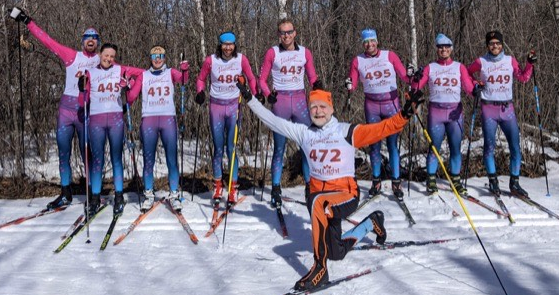
Vakava Team Photo

Vakava Team Photo
Vakava Racers at the Mora Last Chance Race

Sunday, May 8, 2016

Running A PR 5 K: Get In Gear, April 30th, 2016
Back in high school, I ran a couple 5 K road races. I realized these were really really hard requiring a brutal pace for about 20 minutes. This means breathing hard and being uncomfortable for this amount of time. So I pretty much never ran 5 Ks. Well, I did a couple times, never seriously, and hence my PR was in the 25 minute range.
It’s funny how things change over the years and somehow running a good marathon time for me actually made me want to run a true PR 5 K. I started looking for some 5 Ks to do. I didn’t want to spend too much money but also wanted a competitive field and didn’t want it to be too hot. I ended up choosing the Get In Gear 5 K. The race was a bit early in the year which gave me less than 2 months of running intervals after ski season. I felt a bit dumb running a race called “Get In Gear” and a distance of 5 K which is of absolutely no challenge for me; however, the goal was to run a PR, and that’s no easy task.
Part of my goal is to see if I can kick my high school butt. After PRs in track my sophomore year (6:11 mile and 13:35 two mile) I blew up and started running a lot of 2 miles in the 14:30 range and 2.5 miles cross country races in the 19 minute range with a PR of 18:20. Back in high school I always wondered why I couldn’t run consistent 7 minute miles, and now is my chance to try.
Although April is typically considered a month off from structured training for cross country skiers, I trained seriously for a 5 K.
I consider that all my training for this 5 K was in two phases.
Phase one began 15 years earlier when I first joined track. It involved all those high school speed workouts, years of distance but no intervals, then finally getting back into intervals and while continuing distance. I know Phase one is pretty extended, but I truly believe what I did 10 or 15 years ago has an impact on my performance now.
Phase two began about a year ago, around May 1st, which coincides with the start of the training year for cross country skiers. My body felt amazing this whole year. I have never done so many back-to-back interval sessions and distance sessions and still not felt super tired. I’ve just had unending energy this past year. Or maybe I should have pushed harder during all those intervals!
I did some running intervals in November, but no more until March. After the Minnesota Finlandia I started training for this 5 K running race, two months before the event. First I did an altitude block in Canmore where I mostly skied but also got in a couple slow runs. Then I returned to low elevation and began running one speed session and one interval session a week. The speed sessions consisted of mostly sprinting or running fast for up to 1 minute to really work on my top speed. My intervals were 4 x 3 min, 3 x 4 min, and 3 x 5 min. 

Me on top of Ha Ling Peak above Canmore. The trail up this mountain climbed about 2,000 vertical feet. Photo: Erik
 After 3 weeks, I did a second altitude block in Utah. OK, I admit, this sounds absolutely ridiculous, and I really just put this in for effect. I’m pretty sure it’s terrible training to do 2 weeks at altitude in an 8 week period to train for a 5 K. One altitude block was probably sufficient and working on speed and intervals would probably have been more advantageous. The altitude blocks were quite coincidental, coinciding with planned vacations. I decided on the vacations first and the 5 K second. Unlike a marathon, this is a 5 K; they are dime a dozen and require significantly less commitment and so if this race doesn’t go perfect, so what, I can do another one. 
I went to Utah with my friend Amy and we met my friend Kathryn (in picture above) there. We encountered some snow when we tried to climb Mt. Olympus above Salt Lake City. I spent 5 nights total at 8,000 feet making it some good altitude training. Photo: Amy

A selfie on the rim of Bryce Canyon National Park. We did a lot of hiking here and the trails are some of the best I have ever been on...amazing scenery, ups and downs, and very well graded. I didn't have to watch where I was walking and could look around!
Jumping around to get some extra altitude training at the highest point in Bryce Canyon National Park. Photo: Amy
 
Next we went to a slot canyon. This is Little Wildhorse Canyon which is the easiest of all the slot canyons. This photo was too good not to include and will hopefully inspire some readers to check it out. Photo: Amy
No trip to the desert of Utah would be complete without a picture under the iconic Delicate Arch (it's on the license plate after all) but at a mere 4,000 feet, the Moab area didn't provide the best altitude training. Photo: Amy
 After my second altitude block I only had two weeks to run intervals before the 5 K. I started with a 3 x 1 mile workout with only 3 minutes rest in between. My first mile was a 7:06, the second a 7:01, and the third a 7:13. After the second mile I did not feel recovered before starting the third; however, that is the goal of the workout. This is a chance to see what my pace could be for the 5 K. We did this workout twice my senior year of high school and my times were pretty comparable.
I completed my training with a couple more sprint workouts, easy runs, and then one final 3 x 4 minute set of intervals on the track where my latter two average paces were right around 6:15. This was pretty incredible for me and might have been due to a slight tail wind advantage (yes, on a track, largely due to wind direction and a large set of bleachers). 
Ever wonder if it's really necessary for the street sweepers to clean the streets in the Spring? It turns out the answer is yes. This is how dirty my legs got after running on the streets of St. Paul for a speed workout after a rain. This is from running on STREETS only! Signs were posted that the street sweepers were supposed to be out the next day.
 Two days before the race I had an easy 6 mile run planned but seeing as I had ran the two previous days, it was raining, 40 degrees, and April, I thought “What Would Jessie [Diggins] Do? The answer was easy as I curled up on the couch and read a couple more chapters in my book.
So I felt relatively strong and confident heading into the race. I was surprised by how little I thought about it the day before and was even somewhat worried that I didn’t wake up feeling nervous. I wanted to pay $30 or less for the race, but justified the $35 entry fee to Get In Gear because I could run my warm up on the way there and cool down on the way home. It doesn’t get much easier than that. It was a 2.5 mile run to the start with three pull outs at about race effort. I got hot in my long sleeve top and bottoms so was glad I had decided to go just running bra and shorts for the race. Erik did the race as well. We watched the 10 K/Half marathon start which had a lot of really good runners.
There didn’t appear to be many fast people in the start gate of the 5 K. I lined up in about row 3. Usually I ski races for place and run races for time, but this was looking like a race in which I could place pretty well. The gun went off and the race started. I wanted to make sure I didn’t start too fast. I had set my Garmin to get splits every half mile so was right on pace with a 3:33 half mile. My second half mile was a bit slower at 3:38. I passed a couple women and a couple more passed me. I just tried to maintain for the second mile, not wanting to breathe too hard yet. I wanted to race a bit conservative the first and second miles and then ramp up the pace for the third mile if I was feeling good. By the third mile I was pretty winded. I tried to ramp up the pace and did slightly but not really until the last .1 miles. One woman passed me in the last mile. That last mile I was breathing hard and didn’t feel like pushing harder. I also lacked motivation to push further into oxygen debt.
I had set a goal of running sub 22 minutes which seemed possible by averaging a pace in the low 7 minutes per mile. I did underestimate how long it would take me to run the additional .1 miles. My GPS had told me I was doing this well so was disappointed when I saw the finish clock reading over 22 minutes. I was breathing very hard when I finished and was barely walking forward in a dazed state when I finished. I could have pushed harder but it’s so easy to forget how hard I was working at the time. My end time was 22:26. The field was not very strong so I actually finished 8th of 870 women (top women’s time was 21:15). I did have other racers, including women, to run with the whole time which was good. 
My race outfit. My bib had my name on it! I didn't hear anyone cheering for me by name though so I like to think I was running too fast for it to be read (as opposed to my name being too difficult to read/pronounce:). Photo: Erik
Back to a comparison of my high school self, according to my time I averaged 7:14 minutes per mile. Both times are about as fast as many of my 2 mile races in track in high school and both times are faster than I ever ran 2.5 miles in high school cross country! Not bad and a decent new PR benchmark.
...now I think I might take the month of May off from running intervals.

Sunday, April 24, 2016

Ultimate

My husband organizes a pickup Ultimate Frisbee game every Saturday morning with friends. It's the same group of people that I started playing with 20 years ago and were I got to know Jim. They play year round and he claims playing in the winter is the most fun because you can dive for the frisbee without getting hurt. It's a very different game in the snow since you can't run and maneuver like you can on grass. I'm always too busy skiing in the winter to play with them but I usually start up in the spring after I've gotten my legs used to running again. Yesterday was my first game of the season. I haven't done any kind of intensity for some time but I can still run pretty fast when I need to. I just can't help myself and ran pretty hard. It amazes my how it makes my whole body hurt when I start playing again. It truly is a full body sport. My arms, shoulders, back, quads, hip flexors, and even my feet are sore today. My feet must be sore from all the cutting back and forth. The soreness is coming and going in different parts of my body at different rates. My quads and hip flexors were too sore to run today. Hopefully I'll be up for another hard go by next Saturday.


This is a little figurine of a person diving for a disk that my nephew gave Jim. Isn't it cute?!

Thursday, April 21, 2016

Artificial Winter
Each year around April, I like to reflect on my ski season and the training leading up to it.  2015-2016 was my best training year ever in terms of volume, intervals, and still feeling very strong. This training reflected in a “better than I dreamed of” Twin Cities Marathon and was hoping it would catapult me towards some “too good to be true” ski results, but that didn’t quite happen.
There were the not-so-good races. Namely, the series of sprint races I did (Hoigaard’s Relays and the new Master Blaster Series sponsored by Fulton). I have never considered myself a sprinter and still don’t; but doing these sprint races are supposed to make me better, right? Then there was that Ski-Orienteering race as part of the City of Lakes Loppet I really should have cherry picked….and when I didn’t, I was left feeling salty. And then there was the Lake Louise Loppet that left me crying on the course (icing is never fun)!
There were the so-so races: the 5 km team time trial at Elm Creek and the 42 km skate City of Lakes Loppet. My goal at the time trial was to show some improvement over the previous year. It is always hard to judge when competition and snow speed are different. I couldn’t really determine if I was any faster in either the skate or the classic. In the City of Lakes Loppet I just did not feel on top of my game the whole race but ended in 16th place for women which tells me that even on a so-so day I’m not that far back.
Another so-so race: the inaugural Three Rivers Rennet. I'm still sporting my hot pink polka dot suit here. We did four loops of Hyland's man-made loop for 20 km total. I do best climbing. Caitlin Gregg lapped me! Otherwise I held onto top 10. Photo: Skinnyski

Then there were the good races: 42 km Classic Mora Vasaloppet, 30 km Classic Boulder Lake Race, 20 km Classic Finlandia, and 55 km Classic Birkie. The Mora Vasaloppet was fun because I skied with the two lead women (Josie Nelson and Kathleen DeWahl) for about 13 km before getting dropped when I fell. I’ve never stayed with either of those women that long before so I think that at least shows some progress in my double pole. Although I cherry picked Boulder Lake and Finlandia, I was proud of myself for really racing the men and Boulder Lake was the first race I have ever won outright (men and women) AND got to ski with my bro! While I narrowly missed a top 10 at Birkie, I really can’t complain about 11th place. Besides, had I done much better, it would make it hard to set goals for next season. 
Over 200 meters into the Finlandia and still with the lead men's pack (albeit at the back as #2119). I'm the only woman in this group. I went on to beat about half the men in this picture. Photo: Skinnyski

While there were the races, I spent much more of my ski time training. And in both races and training, I did many, many, many loops on man-made snow. We spent Thanksgiving week in Colorado on natural snow which seemed to make the December loops more tolerable but by the middle of January it was getting mundane. Hyland’s snow-making loop is amazing; however, 60 km there one weekend were 20 too many.
By the end of January, my husband Erik, quipped “I need an adventure.”
Skiing and racing loops on man-made snow is not very adventurous.
All my early season races were on man-made snow and then Mora was saved by the little snow gun that could, so hence, only partially on man-made snow.
Entirely man-made races: Hoigaards, Elm Creek Time Trial, Three Rivers Rennet, Fulton Races at Wirth (2 total). This was 5 of my 11 races. 
Racing in the man-made slush at the MYSL/Fulton Team Sprints at Wirth after the Birkie. This was the slushiest snow I've ever skied in. It's interesting how the man-made snow slush is much different from natural snow slush. It's more like skiing through a slushy than mashed potatoes. Photo: Skinnyski

Partial man-made races: City of Lakes Loppet, Mora Vasaloppet
All natural snow races: Boulder Lake, Birkie, Finlandia, Lake Louise Loppet (not sure if this one counts...I did not wax my skis for this race).
In March we headed to Canmore to watch the World Cups and ski on more man-made snow. Canmore has about 20 km of man-made snow! The snow was dirty and since I felt deprived of abundant snow, winter still seemed missing.
Watching Petter Northug and other World Cup skiers navigate the slush on man-made snow at Canmore. It was similar to the slush at Wirth. Photo: Craig

But then there was Lake Louise and Mount Shark. Both locations, higher in elevation than Canmore, offered a true winter experience and provided for just enough real snow time to complete winter. 
Glorious, pristine, abundant natural snow on Mud Lake near Lake Louise. So much fun to be making first tracks. Check out the mountains in the clouds. Photo: Craig

So I was curious to know just how many hours and km I spent skiing at Wirth, Elm Creek, and Hyland this year. Being as Wirth’s loop didn’t open til mid-January, I spent only 6.4 hours skiing there and logged 67 km (time and distance is a bit funny because 2 of the times I skied there were for team sprint races). I skied 20 hours at Elm Creek for a total of 300 km (that’s 120 laps of a 2.5 km loop). By far I skied the most at Hyland- 44 hours in total resulting in 544 km (of which over ⅓ occurred in December when the loop was less than 2 km). That is a lot of time and distance on man-made snow. This is why when I reflect on my 2015-2016 season, two words come to mind: Artificial Winter.
In summary, I think all this training on man-made snow boils down to two points. First, this is indicative of snow conditions in Minnesota. This is not a post about global warming so I will merely state we do not get a lot of snow in the Twin Cities and given that we have so much man-made snow, this is not an unusual winter. Second, this shows just how crazy I am in my desire/need/ambition to continue to train that I spend so much time going around in circles. I seriously wonder how sustainable this is in the future which is why in December I often elected to run or rollerski instead of drive to a man-made loop. It also begs the question, how many hours does a competitive master athlete need to spend training on snow in an artificial winter?

Monday, February 29, 2016

The Minnesota Finlandia!!! February 27th, 2016
The Minnesota Finlandia, or MinnFinn, near Bemidji, Minnesota, is my hometown race. My dad served on the MinnFinn board for many years, and now my brother does. Once part of the prestigious American Ski Chase, the MinnFinn remains part of the American Cross Country Ski Marathon Series. Each year with the banners, announcers, music, and flags from many Nordic nations flapping in the wind, I feel pride in taking part in this legendary event.
Me after winning Axe #2 in 2013 with Paul and Babe in downtown Bemidji. Photo: Craig

Despite arguably the best non-cash prizes in the Midwest (check out this video to see why: https://www.youtube.com/watch?v=w9nRINv7lfA) participation in the MinnFinn is dwindling. I first attempted to remedy this situation while on the University of Minnesota Nordic Club by encouraging and providing lodging for the dozen or so of my teammates who did the race. Due to a limited number of racers, especially in the women’s field, spread over 4 races, a mediocre skier such as myself has a pretty good shot at the podium. In both the mens and womens races, the same skiers tend to show up year after year and collect the same prizes year after year. After winning 3 axes in as many consecutive tries, I again attempted to remedy the situation by making a Promo Video (see link above).
Temperatures for the race were projected to be in the mid 30s at the start and climbing. The day before, temperatures had been in the high 30s. I was racing the 22 kilometer classic race, and Craig and Erik were doing the continuous pursuit. This sounded like klister conditions and so we applied Rex Brown the morning of the race. I was worried upon arriving to the start and seeing the snow was very dry and skied more like it was 15 degrees. My brother later told me this was because they had received about 2 inches of snow earlier in the week “north of town.” I was afraid my klister would ice and was quite surprised and glad when it didn’t.
Due to low snow, the course was changed from its usual 25 kilometer lap, to shorter 11 kilometer laps on the less exposed west side. Hence race distances would be about 22 kilometers (2 laps) for the shorter races (classic, skate, and continuous pursuit) and 44 kilometers (4 laps) for the long skate race. The MinnFinn had posted a couple pictures on skinnyski throughout the week and course conditions looked excellent. Indeed, course conditions exceeded expectations and would have been perfect had it been 10 degrees colder.
At the start of the race, I was busy looking around to find other women in my race. I only saw one other woman, sporting the old one piece high school suit. My bro recognized her as Morgan Sagadahl. Knowing high schoolers can be fast, I was worried despite my bro’s reassurance. The start line was narrow and I lined up in the second row between Matt Lee and a guy wearing a non-descript blue spandex suit who didn’t look too fast. He was doing the classic as well and I vowed to beat him.
The gun went off and despite my struggling to apply power on the gradual descent (one of my continued weaknesses) the top pack of men didn’t get too far in front of me. I made a pass as we headed into the tunnel and for the next couple kilometers the course is rolling. I passed a couple guys and then my brother. As we headed into the flatter double pole section, I decided I needed to go faster so I passed a couple more guys. That guy I started next to, in the blue suit, was ahead of me and I was on the chase. As the course looped back on itself, I saw a couple women behind me in the trees. This gave me motivation to keep going hard.
Most of the first lap was glazed conditions with a few areas of slush. There were two glazed downhills that ended in sun-exposed slush. I almost fell on each of these hills as my momentum changed and remembered about these hills to be prepared for the next lap. The second lap was mostly slush although still fast enough to double pole on the flats.
Some good kick double pole. No other women anywhere! Photo: Margaret Adelsman

About 9 kilometers into the race, I caught up to the blue suit skier. I skied behind him until the hill right before the lap where I was able to stay in the tracks and make up some ground on him as my mom and brother’s girlfriend and others (remember, it’s my hometown race) cheered loud for me. The blue suit skier followed behind me. I had no idea how close the women in my race were, so I kept trying to push hard. I also wanted to beat this guy in the blue suit and through the trees I could see a bright orange suit we were gaining on. There’s a couple steep hills and I tried to herringbone run or run outside the tracks on all but the steepest of these hills. A couple times doing this my skis did ice just a tad but once back in the tracks I was able to shake this.
The blue suit guy stayed behind me in the double pole section but we could see the orange suit guy ahead and so about 16 kilometers into the race, blue suit guy took off. I didn’t feel ready to go with him. This is where I’m still working on racing the guys because I had conflicting thoughts between “I want to do well overall and therefore I need to beat the guys” versus “I’m probably going to win this by a few minutes so why should I push so hard?”
In pursuit of blue suit. Photo: Margaret Adelsman

I was so hot this race I took two glasses of water. That’s a lot for me in such a short race. Usually I wouldn’t take any as I usually operate on more camel mode, feeling that taking feeds slows me down.
Now the blue suit and orange suit were frequently in view. I kept pushing on the uphills, working hard. About 4 kilometers from the finish, I saw blue suit had caught orange suit and about half a kilometer later I passed orange suit. Coming out of the last aid station, with 2 kilometers to go, I was gaining on blue suit. Again, I was thinking about this guy not really being in my race but I said to myself, “Come on, Elspeth, you said you were going to beat this guy, you need to put in some effort. Race for place overall.”
I passed blue suit but he was following close behind. On the last uphill, half a kilometer from the finish, I put the hammer down. I heard John Arenz and the Tibstra’s and Mark Morissey and others cheering for me. I did everything I could to put some distance on blue suit. After I skied through the tunnel and down the small hill heading into the slightly uphill finish with slushy snow, to my dismay, blue suit pulled along next to me. I fought for it, double poling hard, but in the end blue suit got me by 3 seconds.
Passing blue suit the first time up this hill.  Photo: Ashley LaPlante
 
Craig got 1st place in the Pursuit, which was the most competitive men's race. Erik got 4th place in this race. Photo: Skinnyski
After learning blue suit is Beau Larson, who got 149th in the skate race at the Birkie last week (he’s trying to get better at classic skiing), I didn’t feel so bad for not beating him. In the end, I finished 4th overall (men and women), just 3 seconds off the men’s podium! Talking to Beau, and his roommate Henrik Velle, I learned these two were inspired to race the MinnFinn due to my Promo Video! And one of them ended up being my primary competition.
           There were only 3 women in the classic race; I won by 24 minutes. Out on course, I could have easily skied slower and still got first for women, but I’m competitive and as I’ve gotten better, I’m trying to race the men more. Also, Erik persistently tells me how my awards don’t mean much because my competition is lacking, so I’m going to try to save some face by trying not to get guyed! 
Me with my new axe (#4). Note the bison head in the Lumberjack Hall of Fame. Photo: Ashley LaPlante 

 
My axe collection. Calling all women faster than me (you know who you are) to end my reign on February 18th, 2017 at the 35th anniversary.