
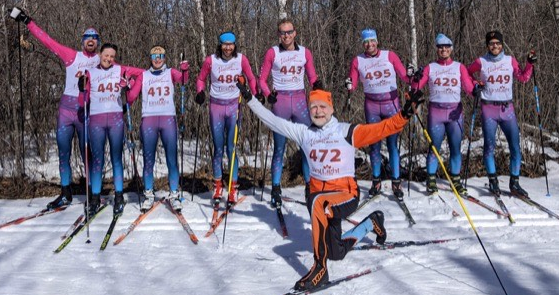
Vakava Team Photo

Vakava Team Photo
Vakava Racers at the Mora Last Chance Race

Friday, November 17, 2023

Training Log Analysis Part Five: What 15 years of Google Sheets Data Tells Me

After a two year hiatus from analyzing my training log, I’m baaaaaack. I’ve procrastinated writing this blog because I’m not very skilled at using Google Sheets. My brother (who has a Masters in Statistics) crunched some data back in 2016 and if I remember correctly, it took him a long time and he said he wasn’t going to help me again. Hence, I had to do it myself, a really long way, the only way I know how.

I introduced my Google Sheets training log in the first series on this theme. As I noted then, I do use the data for the purpose of looking at my weekly training hours. This helps motivate me to hit my average of 12 hours a week but if I’m up to 15 hours for 2-3 weeks, it’s a reminder that I should back off some. Usually this happens naturally due to weather.

In analyzing my data, I thought adding my yearly totals would be most helpful. When I first created the spreadsheet in 2008, this was always my intention but because this data involves 365 rows, it’s much more complicated to compile than the weekly data.

Here are my training totals in hours: 


There’s a few things to note here.

Annual data is from May 1st-April 30th.

I don’t count canoeing as endurance or total hours unless I’m racing. When I’m casually canoeing my heart rate is around 80. If I’m racing, my heart rate jacks up to 120 or so, enough to count as endurance.

When I go hiking or backpacking, I usually count the time spent going uphill only.

Intervals include L3, L4, L5, and races. I haven’t delineated these out. Perhaps it would be helpful, perhaps not. I count the time I’m trying to do these intervals, regardless of my heart rate. And from my previous post, the heart rate conundrum, I’m not always hitting my target heart rate.

I’ve lumped classic and skate rollerskiing together. Prior to 2014, I exclusively skate rollerskied.

So, what is this telling me?

Let’s start from left and move right, thus we’ll begin with total training hours. It looks like on average I train around 600 hours per year. My 2012-2013 season was very light. This was because Erik and I moved back from New York, took 3+ months off from work, canoed from New York to the top of Maine (hence the high volume of canoe hours). We also spent 3 weeks hiking the John Muir Trail, none of which I counted in my endurance hours. I also clocked my lowest running and rollerki hours. I finished 30th in the classic Birkie this season but had the handicap of skiing from Wave 4, which likely put me around 10 places farther back. 


My biggest training year was 2015-2016. Incidentally this coincided with running Twin Cities Marathon. This also coincided with my best finish place in the Classic Birkie at 11th. It looks like my hours were fairly well distributed across the different training domains, but on the higher end of all.

Last year I was down almost 100 training hours compared to the previous year. Initially this surprised me, partly because I was working less, so theoretically my training should have increased. I did start volunteer high school cross-country ski coaching, albeit at most one day per week, but this may explain why my hours didn’t increase. I was relatively close in interval and strength time but significantly down on endurance time. I had more on-snow ski time compared to the previous year, about equal rollerski time, but my running was way down, likely because after a hard running interval session in early November, my posterior tibial tendonitis finally got the better of me. Hence for six months, for most of November through April, when I’m often running up to 3 hours per week, these were all zeros and likely contribute to most of the decreased hours. Interestingly enough, as I commented last year, I had lots of energy for the Mora Vasaloppet, the Finlandia, and especially the second half of the Birkie.

If I use my classic Birkie finishes, by far the largest field in which I compete and mitigating my handicap from 2013 of skiing from Wave 4, I finished in the upper teens in 2014, 2015, and 2018. Yes, my training hours were rather consistent but also seems like all that canoeing and hiking in 2013 didn’t really affect my Birkie performance.

Moving farther right, I’m going to skip over endurance which largely parallels my total training volume and next discuss interval time. I joined Vakava for the 2014-2015 season. I’m impressed to see I did more interval time on my own the year prior to joining Vakava and now have settled into around 45 hours of intervals and races, peaking in the 2021-2022 season when I didn’t feel very sharp for the Bikie. As noted above, my Birkie results are fairly consistent and I can’t draw any obvious conclusions from my interval training. 


Looking at strength is a bit erratic. I hit big hours 2010-2012 when I was a grad student and last had a gym membership. Despite all those hours, I’m pretty sure they were ineffective, lifting largely free weights working isolated muscle groups. The last couple years I’ve tried to incorporate a lot more leg strength into my routine and am hitting bigger hours again, but not even half of my max hours. I’m doing mostly multi-muscle group lifts and trying to do these with weight (pull-ups and squats) and this feels way more effective than ever before and crazily enough, I’m feeling stronger than I ever have before. How do I know this, well this summer I achieved a 20 year goal of benching my body weight, this after I hadn’t benched in 3.5 years!!!

Next I’ll move to rollerski time. I’m shocked I rollerskied a whopping 167 hours back in the 2009-2010 season, all on my OG Marwes. I’m still rocking them (got ‘em in 2004, replaced the wheels a couple times) but have mostly only been putting in 100 or so hours on rollerskis. While I think rollerskiing is good for technique and intervals, I often find that with flat terrain my heart rate is much lower than running unless I’m going uphill, hence probably not great to use as exclusive training.

I’ve broken down my ski time into classic and skate. 2011-2012 was a terrible snow winter in upstate New York and I only skied 45 hours that year! Otherwise in recent years I’ve been doing more classic than skate (except when I did the skate Birkie in 2019 and 2020). It’s interesting comparing 2018-2019 to 2019-2020. While I skied more the first year, I rollerskied more the second. My best ever classic Birkie place in 2016 was not the year of my highest ski volume, but it was near the top.


Regarding running, I ran the Twin Cities Marathon in 2015 and then got on a running kick for the next couple years. I’ve already been over last year’s low numbers. As mentioned above, my best Birkie Classic place happened the same season as Twin Cities Marathon and I had some of my highest running volume; the same did not hold true for 2018, following probably my best ever running race in 2017 and still high volume.

Most of my bike time is commuting. I almost never have my heart rate monitor on. I try not to be too lazy of a biker, but biking isn’t really my jam and I’m sitting so probably isn’t the best cardio but also feels like I’ve done some work, so I count it. I’ve heard of coaches who only let skiers count a third of their bike time and others none at all but I think this is wrong. 


Finally, my canoe hours have waxed and waned, hitting an up-tick when the pandemic started. I don’t think there’s much to learn from this to correlate with ski training, although I could be wrong.


After compiling all this data and making a bunch of graphs, I don’t find this information terribly useful, perhaps because my training has been fairly consistent over the last 10 years, similar in most part to my Birkie results. It’s also not very specific. I’m not looking at specific workouts, how long they were done before target races, my heart rates, etc. As winter approaches, fellow skiers often inquire into my training to which I respond: “oh, about like usual.” According to my analysis, that’s right. I tend to prioritize training, or at least that 12 hours a week average, no matter what else is going on in my life, and usually that’s not much:)


In my next post I’m going to focus on three running races and use more specific data and heart race analysis to drill down on optimal long running race workouts and tapering. In my last post of the series, I’ll do this again to compare my skate Birkie races from 2019 and 2020.

Tuesday, October 17, 2023

Secrets to Being a Faster Skier #6: Cornering/Transitions/Putting it all together

Cornering: Here I mean cornering on flats, uphills, and slight downhills. By using the below cornering technique (aka the “marathon skate” around corners) you can generate significant speed coming out of the corner. And, it’s ridiculously fun! Marathon cornering is my favorite thing to do on rollerskis/skis. It doesn’t require much balance and when done correctly, it generates a lot of power.


You can also do this cornering technique on classic skis. According to the 2018 FIS International Ski Competition Rules: “Turning techniques comprise of steps with the inner ski and pushes with the outer ski in order to change skiing direction. The sections of the course where turning techniques are allowed must be clearly marked.”


Here’s how to corner step by step:

1. Pole on the outside cornering ski. This is a pole similar to V-1 that starts when the ski is set down.
 

2. Next take a small step with your inside ski


3. Step with your outside ski to bring it parallel to your inside ski and as you put it down, immediately begin your poling phase and repeat.
 

Again, the pole timing is the same as V-1. Here’s a video that explains this well.


When I first learned this cornering technique, I was much better at turning right, likely because I’m a natural left sided V-1er. If one side is easier for you, practice that side but also think about what you are doing and force yourself to do it on the other side. You’ll know you’re getting good when you’re getting your skis up in the air! 


Super impressed with this skier's cornering technique (farthest left skier with yellow on top and blue on bottom) during the 2004 Bemidji High School Relays.


Transitions: Anytime you are switching technique (i.e. from free skate to V-1 if skating or double pole to kick double pole or striding if classicaling), this is a transition. It’s important to think about where to make that transition. If you are reasonable at V-2, you may want to V-2 into a hill until you begin to “bog down” or lose energy. Then switch to the V-1. Think about where to free skate and whether you’d be faster or slower using the V-1 alternate or V-2. As you approach a corner, think about what technique you will use going into the corner and what technique you will use coming out of the corner. This will depend on whether there’s hills on either side and if they are going down or up.

Practice lane changes for classic skiing. In citizen racing it’s possible you may never employ this technique in actual competition, but it will improve your balance and poling power.

Practice starts and sprints for finishes. If it’s a classic race, play around with double poling off the line versus taking a few short running strides (not recommended for a mass start race). For practicing skate starts, work on the transition from a high-powered double pole into a V-2.


Putting it all together: Whether in practice or racing, think about skiing each part of the course as fast as possible. The terrain, your strength, your strong suits, the conditions, etc, all dictate what technique you should be using when. A lot of skiing is about efficiency and what is most efficient for the skier. Let’s take a gradual uphill for example, I’m strong at double poling and so would usually prefer that to striding but if conditions are really slow, I may need to stride. The same goes for V-2 vs V-1. I know I’m faster V-2ing and will try to stay in a V-2 longer than others because as soon as I start to V-1, I fall behind. I hope you’ve learned from this series to not just think of the uphills as the work in skiing, but to think about how to get faster on the flats, corners, gradual downhills, and steep downhills. These are all “working” parts of the course. I also find it much more fun to ski this way. 


My bro skiing just a few years ago using a combo of the free skate and tuck.

That concludes this six part series on secrets to being a faster skier. By now your side abs should be getting plenty strong to support all that playing on skis, downhills, and cornering. If anyone is thinking “I only have a few hours a week on skis, I don’t have time to work on these secrets” I’d counter that skiing is a lifelong sport. You will be doing this for another 10, 20, 30, 40, 50, etc more years. Doing these drills will keep you more agile, prevent injury, give you confidence, and help you age on skis. Plus, they are fun and can ease some of the boredom of machine-made snow or golf course loops.


And should you ever find yourself transitioning to cheering, DO NOT FORGET the boombox (oh yeah, and the video recorder:)

Wednesday, September 27, 2023

Secrets to Being a Faster Skier #5: Downhills

Now we’re getting into the real meat and potatoes. Downhills are where skiers can get faster with the least cardiovascular effort. While many of you won’t be surprised, I suspect an equal number of you will be surprised to learn that I can race the entire Birkie Classic course without snowplowing. Now yes, I do have an advantage skiing out of the Elite Wave where the snow tracks are just about pristine but I also practice downhills as part of this cross-country skiing sport. If you are someone who dreads the downhills, does lots of snowplowing, or falls frequently on hills, keep reading.

While I’ve generally sought out hills more than avoided them, there are hills that scare me. There are ones I’ve been down hundreds of times but still check my speed (and this is always condition dependent). The things I’m going to talk about to make you better are things I’ve actively done to ski down hills faster and more confidently. These are the things that help me.

What to do when you feel confident: If you are on a downhill where you feel confident, your goal is to generate as much speed as possible. There are three parts to this. First, it’s important to pole (whether double pole or V-2) fast into the hill – even doing 3-4 sprint strokes as you begin skiing down the hill. Second, get into your tuck as quickly as you can after ending your last poling phase. What is the tuck? Well, it’s aerodynamic and ideally not too much of a quad burner. I like to rest my elbows on my quads (see photos below). I find that a deep knee bend is more of a quad burner so find the sweet spot with a little less knee bend. Third and finally, think about when you are going to end your tuck and what technique you are going to do next. This may be a free skate or V-1 or V-2 or alternate or double pole. The trick here is to transition when you can get more from your poling than the glide you get from continuing in your tuck. Note, this is also dependent on the race distance. If I’m doing a 5 km and my tempo and power are both high, I will pole farther into the hill and begin poling sooner than when I’m doing a marathon.

The snowplow police himself demonstrating good tuck position -- back flat, knees bent, elbows resting on thighs, poles pointed back, and feet close together. Minnesota Finlandia 2023. Photo: Dave Harrington 
Kerrie Berg and I tucking on a downhill. Note how far apart my legs are. It looks like I'm about to snowplow. Obviously I didn't feel completely confident on this downhill. Good thing Dave Harrington captured this photo in the 2023 Minnesota Finlandia so I know what to improve on! Kerrie looks very good here.


How to corner: This one gives people lots of trouble. I’m married to the snowplow police; his pet peeve is anyone snowplowing, especially me. Skiers often snowplow to slow down to go around corners. While this can be effective, the snowplow is much slower than the other three techniques we’ll discuss, is less stable, and it wrecks the trail for everyone else.

First technique: if you are absolutely crazy you can ride tracks around all sorts of wicked corners. I’m admittedly terrible at this and freak out at the easiest of bends. I prefer when the tracks get pulled up like they do on the World Cup. But there’s a couple techniques to this. Actively try to turn your feet towards the direction where you’re wanting to go while pushing down and stick your butt towards the outside of the corner. Yes, this is why you see me sticking my butt out so far to the side:) If anyone wants to learn how to do this like a pro, track down Andy Brown or Zach Handler.

Second technique: the step turn. This is the preferred technique as it is fastest. It literally involves stepping around a turn. You can take small steps (Klaebo was doing this last year on the World Cup in Les Rousses when he went outside the berm and step turned around while everyone else skidded) or medium turns, or really big powerful turns. I prefer medium to large turns, making them powerful. As you turn, you want to dig in your inside edges for maximum power push. It’s relatively easy to do this on the outside ski, but think about doing this on the inside ski as well. This can really help with that “lean” into the corner.  


Step turning around a corner at Wirth during the 2016 Loppet.


But here's some better cornering at the Loppet by teammate Paul. Note his lean and how close his feet are together. Photo: Skinnyski.com

 
And another lean and big step by Alex during the same race, same corner. Pay attention to his good ankle flex on the gliding ski. Photo: Skinnyski.com

But there’s more to technique here. First, you want to assume a position somewhere between the athlete stance (knees bent, shoulders rounded) and your tuck. If you feel very confident and the curve is minor, you may be able to stay in your tuck. The more step turns required, usually the higher the body position. If it’s a 90-plus degree corner, use your arms. I tell people to keep your hands a bit in front of you and down at waist level. This helps with balance and is a good trick. Just watch the pros! If you don’t feel comfortable doing this, read on below.

Third technique: the skid turn. This one may be the most fun and is good for those corners that are “simply” too fast and too big to allow for step turning but does kill some speed. Some people find it easier to get into a short snowplow before engaging the skid turn but the best can go immediately into the skid turn.

How to do this? Well, this is probably the least natural of the ways to turn and has taken me some practice. I often find myself instinctively skidding these days without thinking about it when I decide to turn late at a trail intersection. Essentially you want to put weight on the inside edges of your skis simultaneously. This is easier said than done so start practicing, first at lower speeds, then increase your speed.

This technique can also be fun on a wide but steep trail to curb speed (think Psycho trail at Galena in Idaho or if you ever bring your skinny skis to a downhill area).

What to do when you don’t feel confident with speed or turning:
First, assume the athletic stance. Round the shoulders, then get the hips slightly forward by flexing the ankles and bending the knees. Bounce a couple times, arms swinging gently at the sides.

I think the best way to gain confidence if it’s a two-way trail, is to start at the bottom of a hill you aren’t comfortable with, ski up a ways, and then ski down and gradually increase this by going 5 feet higher up the hill each time until you feel confident in the tuck position (and going around corners using one of the techniques listed above).

This isn’t always possible though if you are skiing somewhere that is one-way. Thus in the case of a one-way hill, I advocate for repeating the same process but controlling your speed on the upper part of the hill until you feel confident to let it rip. Usually it’s most effective to control speed by snowplowing but you can also stand up tall and put your arms out to the side (poles dangling vertically, not sticking out horizontally). Or, this is a good time to work on your skid turns before then working on feeling comfortable at high speeds in the lower part of the hill. Think the upper reaches of Boulder Ridge on Hyland's manufactured snow loop.

Similarly for cornering, first try step turns on hills with gradual corners that only require a couple steps. Work up to the hills that require multiple steps. If this is daunting, control your speed BEFORE getting to the corner, then step turn around the corner at a speed that feels good to you. The more you do this, the faster you will be able to go around corners step turning. Also, the inside of the corner often gets icy. Hence I like to step turn around the outside of the corner, particularly if I think the inside will be icy. Yes, this is slightly slower BUT it provides me confidence and control. If there is a big berm on the corner from a bunch of people snowplowing before you, usually there is adequate room to ski on good snow outside the berm.

Snowplowing: Even though I’m married to the snowplow police, I still advocate for (and use myself) some judicious snowplowing. The wider the snowplow, the slower you will go. Consider a narrower snowplow. I’m a fan of the “pulse” snowplow where I use brief but effective snowplows (by digging in both my inside edges) just enough to slow me exactly how much I need. I also try to NEVER snowplow around corners because this technique is completely out of control. The step turn is far superior.

If you’re still having trouble, talk to yourself out loud. If you don’t believe this works, check out Chapter 8 of my book.

Confidence is paramount. Lacking confidence? Talk to yourself out loud. Bounce with a knee bend on your skis. Get your hands low and in front of you. This last advice alone should make you confident.

Pay attention to your poles and whatever you do, DO NOT stick them out to the side lest you make everyone else around you mad. This also screams that you suck.

There’s nothing I love better than doing some hard step turns around a corner, leaned in, on the verge of my limit, getting that rush skiing slightly beyond my ability.

Sunday, September 24, 2023

Secrets to Being a Faster Skier #2: Free Skate

 Perhaps an underused technique other than by Jessie Diggins (check out her win in Obertsdorf during the 2021 Tour de Ski), the free skate is simply skating without poling.


OK, so we will make it more complicated.

Use this technique on fast flats or gradual downhills when you’re either going too fast to pole or fast enough that you don’t have the technique to benefit from the poling. If you find yourself casually gliding or flailing, this is the place to free skate. Think long gradual hill coming back from the Willow Loop at Hyland or just about anywhere with a gradual descent at Elm Creek on the manufactured snow loop.

But don’t just casually cruise along.

Here’s how to do it effectively.

First, get down in an aerodynamic position. This assumes some bending at the waist, slightly hunched shoulders, good ankle flex, and resulting knee bend.

Second, use your legs. You’ll have to play around with what works for you. If you’re going in for the sprint, a really fast tempo might be best. Otherwise I’d recommend a little slower tempo. I like to put in a little extra “push” or “hop” as I switch skis.

Third, definitely swing your poles like the speedskaters do. Arm swing speed should match leg speed and can be a good way to add in more power.

This should be relatively easy to practice on rollerskis so start giving it a go if you don’t already. Again, it’s a good way to improve your ski times!