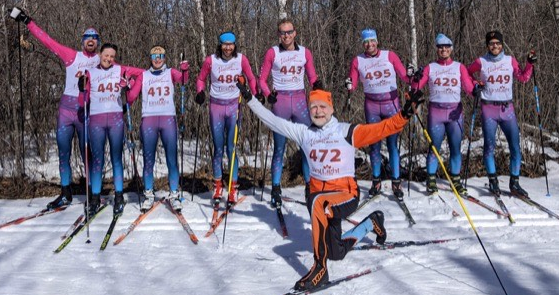
Vakava Team Photo

Vakava Team Photo
Vakava Racers at the Mora Last Chance Race

Tuesday, September 12, 2023

Secrets to Being a Faster Skier #3: Play on skis

This is largely intended for beginning or intermediate skiers who don’t feel comfortable on skis or rollerskis or who feel (or have been told) they look “stiff.” These are some precursor drills to true agility drills. At the end I’ve included some more advanced skills to play with technique. If you feel “too advanced” for these, I’d recommend going through them quickly just to make sure and then tuck them away to teach to newer skiers.

Since it’s rollerski season, I’m going to go through these specifying rollerskis but they can easily translate into being on skis on snow.

If you don’t feel comfortable doing these on pavement, do them on grass first and then progress to pavement. You can use these are a warm-up or do them after your warm-up. If you really don’t feel very comfortable, I’d recommend even repeating this during your session. 

Don't worry...we won't do anything quite this advanced:) Not sure who took this photo circa about 2006 of my friend Jordan who was cheering during the City of Lakes Loppet


First with poles off, go through the following drills:

Side steps: simply step side to side (about 3 steps) without getting any glide.

Weight shift: shift your weight from ski to ski, again without any glide.

Make sure your legs are about shoulder width apart, you have rounded shoulders and a very slight hunch in your upper back. This is the “athletic stance.”

Keep a “soft knee”. To achieve this, bounce on your skis. You shouldn’t get your skis off the ground but instead feel the flex in your rollerskis as you flex your ankles forward and you knees bend.

Now shake out your arms by actively shrugging your shoulders and then letting them drop quickly.

Double check, do you still have a soft knee?

Swing your arms.

Put your hands on your hips and twist from side to side. Your core should be tight but your knees should be soft.

Bounce again.

Now grab your poles. Start by doing some lunges (works best on skate skis).

Then do double pole starts: practice “falling” onto your poles and let them catch you. Don’t actually pole. Just let your poles catch you.

Now balance on one leg and get a good knee bend, flexing at the ankle, like you would at the bottom of your V-2.

Now do V-2 starts by practicing falling onto your poles on only one leg. Again, don’t actually pole so you can do a number of these. Just catch yourself with your poles after you crunch your abs and “drop” onto your poles.

Finally, get on a grassy hill and practice just running up the hill. 

This is why we practice running on skis -- for those once-in-a-lifetime downtown sprints! Photo: Skinnyski.com


Now you’re ready for the advanced drills:

Try to do a speed skating start by taking quick skate steps without getting any glide. Try this first on a steep uphill. I honestly can’t quite get it.

Play around with super slow V-2. Think about slowly bringing your non-gliding leg back under you.

Do the “locked and loaded” drill whereby you pole with only your core but keep your arms locked out at about 90 degrees.

Practice some slow but very powerful V-2 strokes.

Here’s my latest “trick” which is doing “tuck the feet under” as I call it, used for world cup sprint starts. I’ve began implementing this into some of my general double poling, particularly up hills, and I feel some extra power and Ahvo tells me I look good:) 

Screenshot from this year's video technique session w/ Ahvo where I'm practicing the tuck my feet under. Kinda blurry cause it's from a video.


And to appease Erik, end with the frog ski: double pole with your legs together and then let them drift wide. When they get about as wide as is comfortable, jump to bring your legs back parallel and pole again.


Happy playing!

Saturday, September 9, 2023

Secrets to Being a Faster Skier #4: Watch the pros

YouTube some World Cup or World Champs or Olympic footage of sprints. I’ve embedded some links below as I discuss particular sprints. 

We’ll focus on sprints here because it shows agility, power, and tactics well in keeping with the theme of this blog series. Specifically note the following when watching the skiers:
  • Their stability. They usually have their body weight directly over their skis. They rarely bobble. They rarely sway side to side. This is due to that side ab strength.

Watch skate skiing. Note where they free skate. This is often done when coming off downhills onto flats. If you don’t see any free skating, the course probably isn’t conducive to this technique and consider watching a different race.
 

Next watch the agility and the “playing” on their skis.

  • For skate sprint starts, watch how they tuck their feet behind them for the starting double pole.
  • For classic sprint starts, notice how most athletes take a few quick running strides off the line.

In the next post, I’m going to talk about skiing downhills. Specifically when watching the athletes note the following about downhills:
 

  • What they do before starting down the hill or as they crest the hill before the downhill. Usually they put in some extra power and even continue poling into the downhill.
  • Tuck position is very aerodynamic.
  • Watch their downhill cornering: step turns or skid turns. Pay attention to their arms. Note that they usually have their hands low.
  • Note the occasional snowplows, standing up to decrease speed, and how Kleabo will step-turn around the burm where everyone else skids (particularly during the World Cup race in Les Rousses France in 2023. I was unable to find any video of this on YouTube though).

And for the next-next post:

  • Note when they decide to use the different techniques (double pole, kick double pole, striding for classic and free skate, V-2, V-2 alternate, and V-1 with skating); see how this changes on different courses.

Saturday, June 24, 2023

The Chippewa Triathlon

Twenty-one years ago, at age 17, I participated in my first Chippewa Triathlon. The experience had such a profound impact on me I devoted an entire chapter in my memoir to this race. Over the next decade plus, the Chippewa Triathlon was a regular on my calendar, but then in 2016, I stopped the annual trek to Cass Lake, and haven't missed it much. It's been so long since I've done the Chippewa, I wasn't even blogging back then. 

Kathryn and I paddling the Chippewa '04 edition in a borrowed wood racing canoe!

The Chippewa Triathlon course has changed little over the past two decades. While touted as 50 miles total in distance, it has become less than that throughout the years. The canoe/paddle leg is still the same and follows an old trading route from Pike Bay to Steamboat Lake with annual slight course re-directions based on wind and water levels. The bike course has been slightly shortened and includes a mix of paved bike trail, gravel roads, logging roads, and "single track." The run course has also been chopped since my first year, now down to a meager 5.5 miles. 

Official Chippewa Triathlon course from the website.


At the finish. Probably '05.


Back in 2016, I needed a break from training for three different sports and rollerskiing. I was relatively new on the Vakava Racing Team and trying to get the hang of classic rollerskiing. Plus, I didn't miss the run-with-your canoe portages, the poison ivy, the "loon shit," the mosquitoes, sinking my bottom bracket, the sand caked on my water bottle nozzle, heaving my bike over giant down trees, the dead jog after getting off my bike, and running in the ditch along a sunny Highway 2 through the poison ivy.


Ha, often felt like I spent more time off the bike than on it!

But this is arguably why the Chippewa is so great. It's not one of those Tough Mudders or Warrier Dashes, It's the real deal. Just the participants in a national forest with "route finding" labeled as part of the "fun." And it's ridiculously cheap. The first year I did it, my partner and I took a wrong turn on the canoe. The last year Erik did it, he and fellow Vakaver Craig took a wrong turn on the last portage and added 20 minutes to their time. 

I've been thinking about getting back into the Chippewa for a few years now. This year, after an eight year hiatus, I returned, largely inspired to do it as a relay team with my bro biking after he went to sign up for the Lutsen 99er and found it sold out. My bro was our biker back in 2002 when my friend Kathryn and I teamed up in the canoe for our first ever Chippewa. Since then, he's eeked out a few doubles finishes, but mostly he's just posted the fasted biking leg on relay teams for several years.


My bro on the bike course in the early years.

So we decided that Erik and I would paddle, my bro, Leif, would bike, and in the end, we ended up tag-teaming the 5.5 mile run as we're all kinda gimpy runners these days. 

The Chippewa Triathlon has been labeled "A Paddler's Tri" and historically has largely attracted the canoe racing crowd that has significant overlap with the cross-country ski racing crowd. The best canoers do so in skinny racing boats with carbon fiber paddles. While Erik and I essentially have this equipment, we've never been able to break into the canoe racing scene. We're much more efficient at slightly slower but all-day-steady paces. This year, as we have the past few years, we've spent our spring focused on canoeing, but mostly have been paddling new rivers and haven't done many intervals. Yes, real canoe racers do paddling intervals. So while we'd spent some 70 hours in the canoe together this year before the "Chip," we didn't exactly have big expectations for the canoe leg.


I believe this was the second year Kathryn and I canoed together, '03.
 

Saturday June 10th, 2023, Chippewa Triathlon Day, dawned cloudy with a strong wind from the northeast. Race organizers decided about 15 minutes prior to the 7 am gun, to start the race in the more protected Pike Bay, rather than the traditional start in Cass Lake proper by the wayside rest. This created quite the confusion and difficulty getting in the canoes due to waves. Once most of the boats were assembled, we kept waiting for an official start but none came and we kept waiting. Finally about 7:10 am someone in the field yelled "let's go!" and the race went off. Erik and I were already behind as we had tucked into some weeds out of the wind rather than waiting in the main pack. After a frenzied few minutes of high turnover and falling behind, I told Erik we should just settle into a good rhythm and not burn ourselves out. Erik and I are both "come from behind" athletes in general and our strength is usually in the second half when we pass people who went out too hard. 

Chippewa Triathlon start 2004

So we settled but were still paddling hard. All the racing boats were long gone and we were paddling by a few solo kayaks and stock boats (canoe lingo for Minnesota IIs). We paddled next to two women and a number of mixed boats while Kerrie Berg and Andrea Patton (one of my contemporaries from high school) kept up a sizeable lead on us. Due to the wind, we followed the east shore of Pike Bay which adds a bit over a mile to the course. There were some giant pink flamingo floats serving as our course markers which were more fun and provided better visual guides than the traditional milk jugs often used. By the time we made it to the first pink flamingo, a little over a mile into the canoe leg, our serious canoe racer friends Emily and Chris were already out of sight. 

As we turned south along the eastern shore, we began to slowly drop the canoes behind us and catch up to the pack in front of us. We were nearly done with Pike Bay before we finally passed Andrea and Kerrie. It's crazy cause these women are my rivals in skiing and when I'm doing well I can keep up with Kerrie for quite awhile (haven't directly raced Andre in a few years). Erik is a much faster skier than both of these women. But in the canoe, even though they paddled a stock boat with wooden bent-shaft paddles (that Erik taught them how to hold before the start), and this was their first time in the boat together this year, and they didn't have foot braces, and kept zigzagging their steering, they were still stronger than us for 4 miles! 

Alas, as we finally passed them, I vowed I'd make Erik do 30 pull-ups before dinner every night. When paddling doubles, it's easy to blame the other partner for being slow. Maybe it's Erik, maybe it's me, maybe we're both weak paddlers.


More archives: Leif doing the Chippewa w/ Matt Grundy in 2005. Photo: Judy Grundy. Leif got that lifejacket at Sears in what is now the big Midtown building in Minneapolis.

Anyway, at the south end of Pike Bay we made it to the very short portage into Ten Section Lake. Here a whole crew of volunteers were on hand to make sure we dumped out any water from our canoe and toweled off our boats to prevent invasive species upstream. Then we embarked on the poison-ivy infested portage to put-in on Ten Section Lake. This lake is super short and we tried to pass a couple boats unsuccessfully before heading into the slew towards Moss Lake.  

From my recollection, the slew is a thick channel that we usually shove our way through and then eventually get out and portage through some mud on the left side. This is where I lost my water shoe the first year I did the Chippewa Triathlon. The local canoe club paddles this section of the course the Tuesday before the race and this year warned that we would not be dry by the time we got to Moss Lake. I had decided to wear my Alaska boots that are only knee high and really didn't want to go through water deeper than that. So when we couldn't paddle the canoe any farther, we got out of the boat. I gingerly walked along the side on some thick swamp grasses while Erik pushed and shoved the canoe up the slew. Sometimes he was only a foot deep in muck, but several times the footing underneath him gave way and he sunk to his crotch. 

Dave Harrington paused in the middle of his race to capture this wicked photo in the slew this year.


Erik thus became a bit frustrated that I was wearing those Alaska boots and didn't want to get too wet but I'm pretty sure his solo heaving was more effective than had I been trying to help and taking baby steps. 

I ended up behind Erik on the portage and so carried the stern. When we went to put-in on Moss Lake it just made sense for me to jump in stern so even though it's not my strong suit, we traded for that small lake. This also meant that when we did the next portage, a half miler, I got to carry the stern which we've both determined is easier than carrying the bow- probably because the stern walls aren't as high. Our plan was to run the portages but this one was single track and the stock boats in front of us weren't running, so after awhile we just ended up walking which was frustrating cause otherwise we could've made up some time. 

We put in relatively quickly on Twin Lake and were duking it out with a team of doubles men in a Minnesota II but they got in front of us for the "Beaver Dam" between Big and Little Twin Lakes and we ended up doing this super slow with me trying to not sink my boots and we lost a bunch of time. At least we made it up on the next short portage that we ran. 

Another gem by Dave Harrington. Erik and I were duking it out with this guy (and probably his son) just about the entire race. They got in front of us in this slew and Erik and I are right behind.

After paddling across Lake Thirteen, we took off on another portage. The first part of this follows a gravel road and I was hoping to run and make up time but Erik made a rookie mistake of not securing his paddle when we went to dump out extra water AND the teams in front of us were annoyingly running this part of the portage so we never quite caught them. The second part returns to the woods for some single/double track and we were right on the heels of a large group for the next lake, Little Moss. This is a small lake and soon we were in a line at the west end where there's a "boardwalk" to get out on. Fellow Vakaver, Maria, was doing solo canoe and holding up everyone, finding it difficult to hoist her canoe onto her shoulder while slipping on the boardwalk. 

Kathryn and I in action getting out of the boat.

The bow paddler in front of us got out on the boardwalk but the stern paddler in front of us jumped out too soon and sunk to his chest. I got onto the boardwalk and so did Erik. We pushed the canoe alongside us as the slippery boardwalk sections sunk as we stepped onto them. At the end of the boardwalk we picked up our canoe and began running, for this the longest of the portages. It was on this portage back in 2015 that Craig and Erik had taken a wrong turn. We didn't take any wrong turns this year, but my arms were getting tired holding the canoe and when to give my arms a break I put the canoe up on my shoulders, the pain was almost unbearable. 

My bro paddling bow w/ Steve Collison in stern. A couple decades ago.

Finally we made it to Portage Lake but there was another traffic jam putting in off the rickety old dock. The mosquitoes started attacking us at the end of every portage as we got back in the boat and even followed us a ways into the lakes. Eventually we got in and paddled Portage Lake. We'd practiced the next part, called the Snake Pit, a brief meandering stream paddle, two days prior and knew we would be good at it but unfortunately we couldn't paddle hard enough to pass any boats on Portage Lake and so ended up behind in the queue. This was obviously frustrating as we had to slow down a number of times to wait for the boat in front of us to navigate a 90 degree turn. After some patience, we passed three boats to come in first amongst our group although the timers couldn't make out our number on the canoe so the results don't show this (the Chippewa isn't fancy enough to have chip timing).


Another Dave Harrington special, showing a couple different styles of canoe portaging on the portage between Lake Thirteen and Little Moss.

From here my bro took off on the bike and set a blistering pace. Erik wasn't even ready for him when he came blazing into the transition area. Then Leif and I quickly loaded up his bike to meet Erik about two miles into the run where I would take over. The Chippewa doesn't really have many rules and we were signed up as a competitive 2-4 person relay team (there aren't even separate categories for gender), hence there are no rules against splitting up the run. Still trying to rehab my posterior tibial tendonitis, I haven't been running much. When Erik gave me the tag it was on my favorite section of the run course- a wooded low maintenance gravel road with a bunch of driveways to cabins on the lakeside. I took off super fast downhill and by the time I got to some rough single track (branches on the ground and hitting branches on the side), I had to slow down a bit. I was able to run steady though as I made my way through the first campground, then onto the paved bike trail, and then the last road where I saw my bro ready to relieve me. I definitely picked it up then. In the final 1.5 miles or so my bro was able to hold off a few fast-charging runners behind him. We finished second in the team division. 

My Garmin track of this year's canoe course: 14.10 miles. 3 hours and 3 minutes.

 
And my run track.

So, what did I think about my return to the Chippewa????

Well, I was really glad to not bike because at the end of the canoe leg, all I wanted to do was get in some clean lake water and wash off. Both Erik and I ended up with super dirty, mud-stained clothes (don't wear you're good clothes), and lots of stuff to wash and wash and wash. Neither of us got poison ivy. Running shoes with tall socks is best for the canoe. And running with a canoe still sucks.

We also are not gifted canoers. My old high school friend, David, who had inspired me to do my first Chippewa Triathlon and who I hadn't seen in 15 years since he moved out west, was volunteering at the event and when I told him I was going to start making Erik do 30 pull-ups before dinner he said, "Wow, so that's how your relationship works." Now, I was thinking that 30 pull-ups isn't very many since I do 100 pull-up session monthly and this made me realize I have a pretty deranged sense of a normal number of pull-ups. But in the end, it's debatable how much doing a bunch of pull-ups helps with canoe strength. 

I dug deep to find this photo of David finishing the Chippewa Triathlon in '05. Photo: Judy Grundy
 

As an aside, there's a huge upside to knowing the Chippewa Course. I wrote this entire report without looking at any maps. That's how ingrained the course is for me. My bro, fastest bike time, also said this is a huge advantage. There's definitely a big learning curve to doing the Chippewa and despite considering myself a washed up veteran, still feel I have a lot to learn.



Sunday, May 21, 2023

Spring in Norway - Act 2, Lillehammer and Birkebeinerrennet

     After our trip to Bergen we changed trains in Oslo and continued north to Lillehammer, arriving Wednesday evening. We were a bit delayed getting in to Oslo, so we really had to race to get our skis from the storage locker and jump on to our next train, but we made it. I picked up a head cold while we were in Bergen and was pretty wiped out after a long day on the train, so when we got to our AirBnb I pretty much went right to bed. Eva walked to the grocery store to buy me some soup.

    The next morning we hopped on a bus from Lillehammer up to Sjusjoen and got our first look at the race course for Birken, the Birkebeinerloype. We met Erik Hendrickson and a couple other Minnesotans, Taylor and Marianne, to ski a loop up in Sjusjoen. Then Eva and I were going to ski the race trail down to Lillehammer. We had heard from several people that it would be a good idea to preview the long and occasionally steep downhill at the end of the course before racing it. 

    The weather in Sjusjoen was wonderful, we really got lucky with weather our whole trip I feel, or maybe that's just how it is in the spring in Norway. The race course is easy to find, it is 40' wide where it goes through the Sjusjoen stadium, and there were people at work setting up sponsor banners, timing equipment and building snow chairs for the weekends races. The terrain was not what I had expected. In Oslo and Bergen most of the trails were though the woods, and didn't feel that different from trails in the US. In Sjusjoen the terrain was much more open, with stands of trees and a lot of open ground; much more of an alpine feel. The trails themselves were also different, all the trails were wide and the grooming was amazing. The 4 enormous groomers sitting on the side of the trail in the stadium area are a good clue as to why. It also helps that they seem to regularly get fresh snow that packs well and are far enough North that even the mid March sun doesn't transform it very quickly.


Minnesotans in Sjusjoen

    I feel like it's been a while since I've spent much time skiing somewhere completely new, so there was a great novelty factor for this first ski. Norway has an amazing interactive app/website that has all of their ski trails on it at Skisporet.no. In addition to being a great navigation tool it provides a bunch of useful information such as when they were last groomed (including realtime movement of the groomers while they are out), if it is groomed for skate, classic, or both, what the elevation profile of each segment of trail is, and where there are road crossings, bus stops, cafes, and other places of note. As much as I love Skinnyski this website is in another league as far as trail info.

Ski Trails around Sjusjoen - Real Time

    We skied the opposite direction of the race for a while, then turned on to another trail that looped around and back to Sjusjoen and linked back up with the race trail right where it dropped under a road and into one of the steeper sections of the downhill. Eva and I continued down, the other skiers in our group took a different trail back to the stadium.

    The section of downhill right after leaving Sjusjoen is probably the fastest section of the race course. This was the only part of the downhill I was out of the tracks for, and I probably could have stayed in if I'd been a bit more brave. There were several places over the next 10k down to Lillehammer where I got a bit nervous about how much speed I was carrying, but much like rollerskiing down Trading Post in Afton it is just a matter of trusting that things will level out eventually and you'll be able to bleed off some of that speed. It was super fun spending so much time in a tuck just zipping downhill and around gradual corners. We dropped out of the open Tundra and back into the pine trees and before we knew it we were in the Lillehammer stadium where the race finishes. This was the opposite side of town from our AirBnb though, so we continued our ski on a trail up in the hills above the city and after one more long exciting downhill (with a narrower trail and less recent grooming than the Birkie course) we ended up at a trail head only a few blocks from where we were staying.

    That afternoon we walked back across town so we could see what was going on at the Expo. It was really crazy, crowded, with many vendors and lots of fancy ski gear, wax, clothes, energy products, and lots of other outdoor gear as well. Many had really good deals going on too, so we picked up a few things and headed back home.

    There was a lot of fresh snow and wind overnight Thursday night, but Friday morning looked mostly clear in Lillehammer, so we got right out on our skis and skied back up to the stadium to see if we could cheer on Zach Nelson and the other skiers racing the skate Birken (SkoyteBirken).

This was groomed yesterday
    We hiked  up through some fresh snow and eventually got to a trail that was fresh groomed and we could ski it all the way up to the stadium where the race finished. It is a long uphill from town up to the stadium, so we really got a workout skiing up. When we got up there is was oddly quiet, and there were some skiers sprinting around, but no Birken racers that we could find. We finally stopped by one of the fire pits to ask someone what was going on, and we were informed that the race was cancelled. The 9 inches of fresh snow and high winds up on the open terrain meant they couldn't keep the trail in a safe condition.

Hanging out at the finish of the race that didn't happen
    With no racers to watch we skied back down and started to pack up for our trip to Rena. When Eva skied her first Birkie she stayed in the school gym in Hayward, and even if it didn't lead to a great night of sleep she met many friendly skiers and we thought it might be a fun experience to try that here. Plus we could get a couple extra hours of sleep in the morning before heading to the start. We packed up our sleeping gear and race gear and hopped on the bus. When we got to Rena we picked up our bibs and hiked up to the school. There was an expo tent in Rena as well, where I picked up some extra gels so I'd have plenty of fuel for the race. We were staying in a classroom with about a dozen others. We were provided with a foam mat and a chair, pretty minimal, but it worked out just fine. We waxed our skis at a picnic table outside the school. Dinner was lasagna, with a waffle for dessert, prepared and served by the school children for a small fee. Then we headed off to sleep.
Sleeping accommodations
        Race morning was warm and very foggy. We were provided breakfast at the school, then hopped on a bus to the start. My stomach was still a bit off from being sick, so I didn't eat too much. The start was busy, people were panic waxing, testing, elites were warming up, bathroom lines were crazy (there were definitely not enough porta-potties for the number of racers and they quickly ran out of toilet paper). The announcer on the intercom was very calm however, reminding athletes that if they miss their start they can just join another wave and will still get the correct time.
Race Morning
    It was very humid at the start, so Eva and I decided to add a bit warmer wax, even though we were told it would be drier and colder a few km up the trail. I haven't been that confident in my double pole this season and wanted the extra kick. I hopped in my corral when it opened and lined up somewhere in the middle. I qualified into wave 2, but figured I wouldn't be the fastest one in the wave, so I didn't worry about getting right to the front. Everyone is required to carry a backpack weighing at least 7.5 lbs to simulate carrying the baby prince Haakon over the mountains, just like the Birkebeiners the race was named after. Since everyone was packing their warmups in their backpacks there wasn't a crazy rush to get warmups to the trucks and then stand around cold at the start like there often is at the American Birkie. In addition to my warmups I packed all my gels and a 2 liter bladder of water to meet the weight requirement.
In the corral, ready to go!
    The race started pretty relaxed, the front line went out quickly, but everyone else was pretty content to set a fast but relaxed pace and start working into the climb. The course goes uphill for 15+ km with few flats and no downhills, so there is a lot of time to sort out your position in your wave with 10 sets of tracks available. I felt good for a lot of the climbing, I felt like I was working my way forward in the wave and keeping my striding relaxed. I made sure to keep the pace under control with many km of climbing still to go. It was right around freezing, so I had dressed pretty lightly but was still on the edge of overheating due to the hard striding. As we got higher the kick got better and the terrain opened up around the trail. There were some areas where I could look ahead and see the trail way up in the distance. Eva said when she came to some of these areas starting in wave 6 she could see a string of skiers for many km up ahead.
Birken Course
    We finally neared the top of the first climbing section. There was a KOM banner for the Ski Classics series racers, and it was really whipping around in the strong wind as we neared the summit. I saw many gel wrappers discarded along the trail as we neared the peak (despite a supposed penalty for littering). I planned to take my gel on the downhill when I could tuck and relax. As soon as I crested the hill I could see I was outmatched by the skiers around me. They were double poling hard and really being aggressive on the gradual down. I could also tell the extra warm wax was slowing my skis a bit. The downhill was a little over 1km long, and it went by fast! Then it was right in to another 5k of steady climb.
    I clawed back many places on the climb, but once we crested the next ridge there was a lot of down and flat and most of those people raced past me again. I tried to hop on to some of the packs double poling past, but couldn't hold on long. I took all the rest of my gels over the next 15k, but was still feeling the lack of energy due to all the energy expended on the climbing and not fueling enough while I was sick. There was one more long climb, about 7km and now we were out in a pretty warm sun. By the top I was roasting and completely bonked! The last 1/2 km to the summit I was just walking on my skis, I didn't have enough energy to kick and glide. I stopped at the aid station just after the summit and took a couple minutes drinking several cups of energy drink and eating everything I could get my hands on, including some really amazing warm Lefsa with cinnamon sugar. I'm sure I was stopped for only a minute or two, but it's been quite a while since I've needed to stop during a ski race, so it felt like I was giving up a lot of time.
Eva on course just after the high point
    I started moving again and slowly started to get back some energy. There were still skiers passing me, but only a group here and there instead of a steady stream. My main motivation to keep up the pace was that I was still in contention for a 25% prize for my age group. They manage this really impressively, with live billboards at a couple locations along the course letting skiers know what the cutoff time was.
Live Updates on Age Group prizes
    I finally hit the section of trail we had skied on Thursday, and I was feeling refueled and confident that I could at least finish with a steady pace and not bonk again. As the race passed through Sjusjoen the atmosphere buoyed me even further. It was like mainstreet Hayward, but even more rowdy, and with no fences. There were spectators with their fires going right on the side of the trail. There were speakers blaring everything from DJ Tiesto to Neil Diamond to Wu Tang Clan all packed in to a 1/2 km section of trail. Eva said it was even crazier when she came through, with spectators offering drinks and drunkenly trying to help push the skiers up the hill.
    From Sjusjoen it was a crazy rush down to the finish in Lillehammer. My legs were pretty shaky, and the course was already breaking down. The classic tracks were washed out and there were some berms starting to form. I had some energy back, but was trying to use it judiciously so I stayed tucked whenever I could and worked on pushing over the rolling sections to carry as much speed as I could. The last km of the race is completely flat and loops around the edge of the Lillehammer ski stadium to finish right where the Lillehammer Olympic and world cup races finish, so it was fun to experience that, even if the stands were pretty empty by the time I came in. The mood was celebratory at the finish however. After finishing, everyone goes directly through the food line where you get a Norwegian Wurst (hotdog) wrapped in lefsa with ketchup and mustard, an apple, non-alcoholic beer and a red bull. No soup in sight. It was a gorgeous day to be outside and people were hanging out swapping race stories and cheering in the racers streaming by. Erik Hendrickson finished shortly after me, and some of his Norwegian relatives were there spectating, so visited with them and with some other Americans around the finish area including Holly Brooks. After saying hi to Erik and I Holly was visiting with Kristin Stoermer Steira, and when I looked around I noticed her husband Devon Kershaw standing nearby and introduced myself. 
    Devon is a retired world cup racer and Olympian from Canada who now hosts a podcast for Fasterskier covering world cup racing. He has always been one of my favorite skiers to watch and has had an impressive career. He gave North American fans someone to cheer for in mens racing when good results were thin on the US mens side in the 2010's, especially in distance racing. For those who don't listen to is his podcast is world cup commentary and hot takes informed by his continuing relationships with Canadian and Norwegian team racers and his own career as a racer and is one of the best sources for world cup coverage of North American skiers. I usually have the podcast on while I'm out grooming the trails in Northfield, so getting to meet him in person was a real treat!
Devon Kershaw Live!
    I had a long time to wait for Eva to finish, so I skied down to Hakons hall to change into dry clothes, boots, and to drop off extra gear, then took the bus back up to the finish to cheer Eva in. The tracking app was a bit spotty on times and I somehow missed Eva finishing, but her time updated when she crossed the finish line, so I zipped over to catch up to her as she exited the finishing chute.  Zach and Jenna were skiing together and were not that far behind Eva, so we stayed to cheer them in then headed down so Eva could get dry clothes on as well.
Eva and I cheering on racers

Jenna Nelson finishing rocking the US Flag

    We hung around in Hakons hall for a while. I picked up my age group prize and we got our finishers certificates, then we headed back to our Airbnb in downtown Lillehammer and started to pack up for the next leg of our Journey. We had rented a cabin in Sjusoen for a week of easy recovery skiing and relaxed cabin living. Stay tuned for that in the next installment.
    Skiing the Norwegian Birkebeinerrenet was a really amazing experience. The grooming and course conditions were fantastic, yet the course still really seemed remote and epic, and it was cool to be crossing the same terrain as the iconic warriors and their prince back in 1206. I would highly recommend it to any ski racer looking for an adventure race. The competition there is at another level. I finished in 3:49. Not a great time compared to what I usually finish the American Birkie in, but not that bad, and I was only 65th in my age group and 1232 overall. That's the worst place I've ever finished in any race, including the Boston and New York marathons which have 45,000-50,000 racers, so the level of competition there is really impressive. I really hope to go back and try it again soon now that I have  better knowledge of the course and the logistics and can hopefully avoid getting sick before the race.