
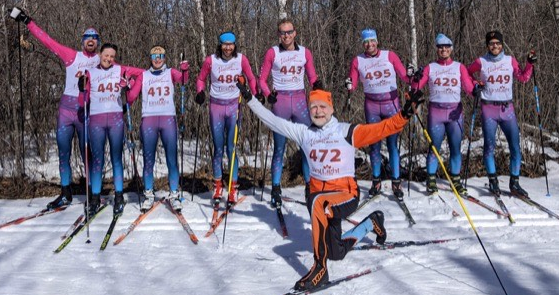
Vakava Team Photo

Vakava Team Photo
Vakava Racers at the Mora Last Chance Race

Wednesday, November 23, 2016

Training Updates

As I get older, I adjust my training to be smarter, both to get faster and enjoy the process more. I’m not always sure I’m successful but it seems I’m getting ever so closer to my goals of skiing faster. Here are a few ways I’ve changed my training in the past couple years.

  1. Running. I’ve been doing a lot of running. This is largely because I ran the Twin Cities Marathon in 2015 but also because running has felt very good recently. It’s so easy to go for a run (hardly any equipment required) and I can run to and from work. I can also run just about anywhere I want which prevents boredom (compared to rollerskiing where I am trying to find good pavement and low traffic roads/trails). It also feels much safer than rollerskiing. True, I have fallen a couple times running, but the risk for injury (and damaging equipment) is much less. Also, when I rollerski, I try to focus on technique which is mentally demanding. In contrast, I don’t really focus much on technique while running and hence am alone with my thoughts. As I’ve mentioned in a few of my last blog posts, most of my intervals lately have been running and therefore I’m getting much faster.

  1. Rollerskiing. I used to go for lots of longer skate rollerskis. Then I started classic rollerskiing and was pretty bad at it. Around this time I heard Laura Bednarski talking about how she was also bad at classic rollerskiing and practiced for 30 minutes everyday. Usually I feel any workout under an hour is not worth it, but to quote Stuart Smalley (Al Franken) in Stuart Saves His Family, that’s “stinkin’ thinkin’.” So I started doing 30 minute classic rollerskis focusing on the striding technique. My balance isn’t great and so that’s what I’m working on. This year I’ve started incorporating shorter (about an hour) skate rollerskis focusing on technique. Again, I’m really working on balance, but also working on using my core strength with my skis underneath me to get a good push off. I find this keeps my heart rate relatively high, hence the shorter duration. This is essentially power that I’m working on- combining strength with speed. I think this has improved my technique a lot and now that my striding is getting better I’m applying power while striding as well.

  1. Biking. Yes, I do count my 6 mile bike commute in my training log. Anyone who knows how heavy my old 10 speed bike is understands. I feel this is both a cardio and a strength workout (especially because I almost always ride in the same gear). While 6 miles one way is hardly very far by bicycle (it takes me 25-30 minutes), it is too much to not count it at all.

    Killing 2 birds with one stone: getting my strength workout on while volunteering at Loppet Trails Day. Photo: Loppet Foundation

  1. Strength. In the past I’ve spent way too much time lifting weights at the gym. I am way more ripped from taking 15 minutes to do 90 pull ups a week than when I spent 3 hours per week lifting in the gym. I also do abs and push ups 3 times per week. I’m always trying to change up my ab routine since my abs are naturally pretty strong so I’ve been incorporating more planks and use of a big ball. Admittedly, I’m terrible at doing lower body strength training but have gotten a bit better at air squats and step ups. Sometimes I like to get in the tuck position between sets of pull ups. This can also be done on one leg to get in some core action and make it more difficult. I’m also a huge fan of doing strength on playgrounds. I love doing monkey bars and rings, but my favorite are the swinging monkey bars. Unfortunately, I’ve never found a long enough set of swinging monkey bars to suit my needs (I’m asking my husband to install a set in our basement for my 32nd birthday!). If the playground has a firepole, I try to climb up it. And new this year, I’ve started doing weighted pull-ups to which I say Bring It On...now if only I could get myself to start doing weighted squats!

     We had a recent 90s Dance Party at our house...I wore my wedding dress...a few skiers showed up...and we had our usual pull-up contest. I stalled out on #10 but I sweat these were really weighted as my wedding dress weighs a lot! Video: my bro, Reid.

  1. Canoeing, hiking, walking, yard work, etc. I only count these things in my training log if my heart rate is persistently above 100. Otherwise I count this in the “Lame-O” category. For our vacations, we often go backpacking. This year we went to Colorado and Glacier National Park. We try to hike about 15 miles per day and I don’t bring my heart rate monitor with me because the battery just doesn’t last long enough. I try to guestimate my uphill hiking time and put that in my training log as real training. Sometimes it’s hard substituting a real workout for one of these Lame-O workouts, partly because then my reported training volume won’t be as high. But these things are important, too, for everyday life, and to keep the mind and body fresh.
    This is how to do a canoe with a bike shuttle! Photo: Erik

  1. Seize the opportunity to train different places. I get bored doing the same routes week after week. Going on vacation is a nice break, but I only do this about 4 times a year so it’s not quite enough to break up the monotony. Going on weekend trips throughout the year helps. Whenever possible, we also try to incorporate one way runs or rollerskis. Sometimes if we’re driving somewhere, one of us will run back home. Recently we ran 16.5 miles to Erik’s parents house and then got a ride back from his parents. These one way adventures are a treat.
    Stopping to eat some thimbleberries while hiking in Glacier. Photo: Erik

  1. Remember some advice I got back in high school from a couple of my team-mates: essentially, leave something in the bank for races. I got told this when I was doing my intervals harder than everyone else or when I was determined to run farther. This concept is about not training myself into the ground and remembering to smell the flowers. I’ve been thinking about this more lately and letting myself bail on workouts if the weather is bad or erring on the side of doing too few rather than too many intervals. Unlike professional athletes, I don’t plan to retire at this sport for 30 plus years; therefore, I have to keep the training fresh.  I’ve given up two workouts lately for Happy Hour with my work group. This is a big accomplishment for me in my exercise-addicted life!

Saturday, October 1, 2016

On Confidence
    Confidence is a strong word. It’s really important in athletic endeavors (like skiing!) and throughout life. Often confidence in one realm of life breeds confidence in another realm of life. Confidence is something felt by the individual, but also something others can perceive.
    Last year, I diligently watched almost every women’s World Cup race because I wanted to know who everyone was and how they were doing prior to watching the World Cup live in Canmore. Throughout the season, Jessie Diggins seemed to be doing better and better. Not only was she doing well at sprinting, but she was doing awesome in the distance races as well. One Saturday there was a 5 km individual start classic race in Falun. Jessie surprised herself and finished 5th overall behind four Norwegians. The next day was a mass start 10 km skate race at the same venue. With what looked like extreme confidence (at least watching it looked like Jessie had mega confidence) Jessie proceeded to try to ski with the Norwegians and was able to do so for awhile, eventually finishing 4th overall behind three Norwegians.
During the 1996 Olympics in Atlanta, I was 11 and had a big crush on the Magnificent Seven (the US women’s gymnastics team). I excitedly watched the team competition which came down to the vault. Kerri Strug was the last US member to go and she fell and sprained her ankle on her second to last vault. She was clearly in a lot of pain but had to land her second vault to secure the gold medal for team USA. It was pretty obvious Kerri was in a lot of pain from her facial expressions but she knew what she had to do and even though she didn’t have a ton of confidence she focused and landed that second vault and man, she she was surprised when she landed that vault! At least per her facial expressions she looked pretty darn surprised. This summer in Rio there was an interview with the Magnificent Seven and Kerri said landing that vault gave her a lot of confidence in her life.
    So where does this leave me in regard to confidence?
    After high school, I was really burned out on running, and in particular, on running intervals. So I declared that I was not a runner and avoided running intervals and running races. Oh, I thought about doing them, but then thought better. Until I got really slow. Six years ago, in 2010, I vowed to become a faster runner and started doing intervals again. This resulted in surprising myself and running a faster Twin Cities Marathon than I believed I could run last year.
    This gave me confidence to continue working on getting faster and made me excited to keep pushing myself through those intervals. I was even motivated to run a PR 5 K even though I had sworn I would never run that distance again many years ago.
    It also motivated me to run a 10 mile race. A year ago, I thought about running a 10 mile race in sub 90 minutes (sub 9 minutes per mile). At the time this seemed like a reasonable goal that would be challenging but likely do-able. Zoom ahead to Twin Cities Marathon and I decimated this goal in the first 10 miles of the race. Hence I needed a new goal so decided to aim for sub 80 minutes (sub 8 minutes per mile). This was definitely fast for me and would be hard and I’d have to train, but likely possible as my PR 10 K is a 46:45 (average 7:31 minutes per mile).
    This year I set my sights on the Bear Water Run, a 10 (1 lap) or 20 mile (2 laps) race around White Bear Lake on September 17th. This event was perfect because I could run the 10 mile and Erik, who is training for Twin Cities Marathon, could run the 20 mile. 
The map of the course. It's just about a perfect 10 miles around White Bear Lake.
    I diligently ran intervals every week alternating between fast 3-4 minute L4 pace (upper 6’s minute/mile) and longer tempo runs at about 7:45 minute/mile pace. I even slogged through some slow runs at 9,000 plus feet in Colorado. On the weekends I usually ran an overdistance run with Erik that was well over 10 miles. Overall my training went well.
    The pace was going to be fast and I somewhat dreaded race day but tried to convince myself once I was in the race the pace wouldn’t seem THAT fast. Yet six years ago, when I was totally out of interval shape, I couldn’t even muster an 8 minute mile and now I was about to string 10 of them together! I wasn’t really sure I could run sub 80 minutes but despite this, I felt ridiculously confident. Despite my doubts, I felt my confidence would carry me through.
    Maybe that’s why I wasn’t too nervous the morning of the race. Usually I get pretty nervous and that’s actually a good sign but I wasn’t very nervous race morning. Erik and I had planned that he would run with me for the first 7 miles, and then he would take off and run the next 13 miles at his goal marathon pace (7:15). I had checked out last year's results and it looked like my per mile time would place me in the top fifth of the race so I also planned to start very near the front.
    I did start pretty close to the front but we started on a bike trail so the start wasn’t very wide. There were some slow people in front of me and I made quick work to get around them. It’s always hard to settle into a good pace and I didn’t want to be checking my watch too much so I just waited for the half mile autolap while I made sure I wasn’t breathing too hard early on. There was a group of runners already way in front of me but otherwise Erik and I were relatively alone.
There was a competition between the water stops for Best Water Stop. Unfortunately I was running too fast to fully enjoy all the fun themes/costumes at the different water stops. Photo: Bear Water Run Race.
    My first autolap beeped in at 7:32 pace. Oops, a bit fast which is often what happens in races, and as I had told myself. I still felt confident because I wasn’t breathing too hard and felt fresh. I stopped trying to push and my pace slowed a bit. My first 3 mile times were 7:37, 7:52, and 7:45.
    Just before mile 4 there was a big uphill but I kept up my pace, clocking my 4th mile at 7:52. There were water stops every 2 miles and I only planned to get water once or twice. I knew it would be difficult to take in much liquid while running fast. I got some water and had to slow to get enough down. Then at the end of the aid station a woman was handing out chocolate! I’d never taken chocolate before and it was like “to take or not to take the chocolate” in a fast 10 mile. I grabbed it and then thought it was probably a bad idea but I don’t waste food so I ate the chocolate. The jury is still out on whether this overall made me faster, slower, or was neutral.
 
I mean, how do you pass up the chocolate from this friendly volunteer? Photo: Bear Water Run Race
    There was another big uphill and then the course got flatter again. I was still feeling good but thinking I should probably get more water at the 6 mile aid station because even though it was only 62 degrees, it was really humid and my hat was soaked with my sweat. I slowed to take more water and Erik got ahead of me and I couldn’t quite catch up to him. My 5th and 6th mile times were getting slower at 8:07 (water and chocolate and uphills) and 7:59.
    At mile 6, the effort got harder which was reflected in my slowing paces. Every half mile I stayed under an 8:10 pace I was elated. By mile 8 I was thinking some good thoughts (Elspeth, even though your are getting tired your paces are still about on target; this is a 10 mile PR, it is SUPPOSED to be hard; Elspeth, you really aren’t breathing THAT hard) and some bad thoughts (this is hard; I want to stop; it’s still more than 20 minutes running time to the finish).

Running so fast I missed this trio at a water stop. Photo: Bear Water Run Race
     Yet at the same time, I felt confident I was going to do this. I just had to suffer a bit longer. My mile times for 7-9 were still pretty good (8:05, 7:54, and 8:09) and I had put some time in the bank early on in the race. I was going to do this.
    I could hear a group of runners catching me. They were talking a lot about running marathons (including Boston) and I assumed they were running the 20 mile race. I tried to speed up so they wouldn’t catch me but they still did somewhere between mile 8 and 9. When they did I said, “stay with them Elspeth, don’t let them get away. Get distracted by what they are talking about.”
    This was a good strategy. One guy was talking about why he was buying a new house. I told myself again that I wasn’t breathing that hard. Actually I noticed that as my legs tired and my stomach knotted up, my breathing got more shallow and I had to remind myself to breathe deeper which did help.
    My half mile splits kept ticking away. One mile to go. OK, I can do this but I don’t feel like kicking yet. Half mile to go. Maybe I should think about starting a kick but I’m not read yet. More breathing. More listening. Check watch, OK, just a quarter mile and we’re nearing the last turn but now there’s a group of people in front of me. Should I go around them? But then I have to go into traffic. Once we made the last the turn,  it was like, OK, gotta go now! So I went around in the grass and at the same time another woman went around the group on the other side. I could not stay with that woman but I did quicken my pace and ran as hard as I could. As I got near the finish the clock was in the low 1:19s and I ended crossing the finish line in 1:19:14. Mission accomplished thanks to surprising myself last year in the marathon and my new found confidence!
    At the finish my breathing was labored (my last mile was a not too shabby for me 7:46), my legs were really tired, and my stomach was quite knotted up. After I stopped breathing so hard and had managed to eat some recovery food, I tried going for a cool down jog but gave this up after 5 minutes because I was running so incredibly slow. This was testament to me pushing really hard during the race. 
Running fast and looking tired at the finish. Photo: Bear Water Run Race

Saturday, August 6, 2016

Women: Just Do It!
Back in high school, there were twice as many girls on my Nordic ski team as boys. At the races, there were about equal numbers of boys and girls. When I went to college and joined a club team, there were twice as many boys. When I “burst” onto the marathon scene in 2004, it quickly became obvious I would be skiing amongst a lot of men, and the occasional woman, for the rest of my “career.” (aka half century)
I’ve thought about this a few times. In running races, women now actually make up about half the field at marathons and the majority in many shorter races. This wasn’t always the way it was, and it has taken about 30 years. So why hasn’t this happened in skiing?
Skiing takes more time than running. You can just run from your door and it requires little gear. But for skiing, you needs skis, boots, poles. You need to wax your skis. Then you need to drive somewhere, change into ski boots, etc. Hence, a one hour ski actually takes at least 2 hours and that’s if you are really efficient at dressing, getting out the door, and don’t have to drive too far. I feel this every ski season. I train less during ski season because I spend so much time driving and dressing and deciding what wax to use and waxing. Men are likely better at making training a priority and likely feel less time pressure than women.
I had a conversation with Caitlin Gregg regarding the paucity of women who ski marathons compared to men. She suggested it’s an equipment thing. In other words, skiing requires lots of equipment (see gear list in the last paragraph) AND waxing. It’s the idea that men are better at tinkering with tools and toys than women (think bikes, cars, etc) and this results in women getting turned off from the sport. We think men might be better suited to these logistics (picking the right wax before races).
Here’s my favorite theory. This is something more innate about men and women. Men have the idea “I’ll just do it, tough it out” and so even though they haven’t trained, their testosterone is going crazy and they’ll get through. Sure, they may get injured and start out too fast, but they’ll finish. Women on the other hand, are smarter. We like to be well trained and prepared for the distance. We are better able to pace ourselves. And so, if we feel we don’t have enough time to train, we’ll be more conservative and sign up for the shorter race.
But the problem with this is, if you never commit to a longer distance, you will never challenge yourself and break through that barrier. When I did my first ski marathon, the Mora Vasaloppet, it was 58 kilometers. I was foolhardy, and even though I’d only ever skied about 25 kilometers at one go before, I did the race anyway. And you know what? I finished and survived. And this gave me confidence to do another one and another one and after I’d done about five, I found myself saying “wow, I don’t even respect this distance of 50 kilometers anymore.” Had I never taken that plunge though, I’d probably never have skied more than about 30 kilometers at one time. Sometimes we have to do something outside our comfort zone, even if we feel like dumb men doing it.
I’ve struggled with how to be nice with other women when discussing this topic, but I really just want to say: women, just do it. So women, here’s the deal:
2016 Birkie Skate: 3662 men, compared to 895 women (women made up 20% of the field).
2016 Birkie Classic: 1913 men compared to 573 women (women made up 23% of the field).
This is pathetic. Let’s do better. Surprise yourself, unleash some of your testosterone (women have it, too) and make the next race you sign up for a full marathon distance.

Sunday, May 8, 2016

Running A PR 5 K: Get In Gear, April 30th, 2016
Back in high school, I ran a couple 5 K road races. I realized these were really really hard requiring a brutal pace for about 20 minutes. This means breathing hard and being uncomfortable for this amount of time. So I pretty much never ran 5 Ks. Well, I did a couple times, never seriously, and hence my PR was in the 25 minute range.
It’s funny how things change over the years and somehow running a good marathon time for me actually made me want to run a true PR 5 K. I started looking for some 5 Ks to do. I didn’t want to spend too much money but also wanted a competitive field and didn’t want it to be too hot. I ended up choosing the Get In Gear 5 K. The race was a bit early in the year which gave me less than 2 months of running intervals after ski season. I felt a bit dumb running a race called “Get In Gear” and a distance of 5 K which is of absolutely no challenge for me; however, the goal was to run a PR, and that’s no easy task.
Part of my goal is to see if I can kick my high school butt. After PRs in track my sophomore year (6:11 mile and 13:35 two mile) I blew up and started running a lot of 2 miles in the 14:30 range and 2.5 miles cross country races in the 19 minute range with a PR of 18:20. Back in high school I always wondered why I couldn’t run consistent 7 minute miles, and now is my chance to try.
Although April is typically considered a month off from structured training for cross country skiers, I trained seriously for a 5 K.
I consider that all my training for this 5 K was in two phases.
Phase one began 15 years earlier when I first joined track. It involved all those high school speed workouts, years of distance but no intervals, then finally getting back into intervals and while continuing distance. I know Phase one is pretty extended, but I truly believe what I did 10 or 15 years ago has an impact on my performance now.
Phase two began about a year ago, around May 1st, which coincides with the start of the training year for cross country skiers. My body felt amazing this whole year. I have never done so many back-to-back interval sessions and distance sessions and still not felt super tired. I’ve just had unending energy this past year. Or maybe I should have pushed harder during all those intervals!
I did some running intervals in November, but no more until March. After the Minnesota Finlandia I started training for this 5 K running race, two months before the event. First I did an altitude block in Canmore where I mostly skied but also got in a couple slow runs. Then I returned to low elevation and began running one speed session and one interval session a week. The speed sessions consisted of mostly sprinting or running fast for up to 1 minute to really work on my top speed. My intervals were 4 x 3 min, 3 x 4 min, and 3 x 5 min. 

Me on top of Ha Ling Peak above Canmore. The trail up this mountain climbed about 2,000 vertical feet. Photo: Erik
 After 3 weeks, I did a second altitude block in Utah. OK, I admit, this sounds absolutely ridiculous, and I really just put this in for effect. I’m pretty sure it’s terrible training to do 2 weeks at altitude in an 8 week period to train for a 5 K. One altitude block was probably sufficient and working on speed and intervals would probably have been more advantageous. The altitude blocks were quite coincidental, coinciding with planned vacations. I decided on the vacations first and the 5 K second. Unlike a marathon, this is a 5 K; they are dime a dozen and require significantly less commitment and so if this race doesn’t go perfect, so what, I can do another one. 
I went to Utah with my friend Amy and we met my friend Kathryn (in picture above) there. We encountered some snow when we tried to climb Mt. Olympus above Salt Lake City. I spent 5 nights total at 8,000 feet making it some good altitude training. Photo: Amy

A selfie on the rim of Bryce Canyon National Park. We did a lot of hiking here and the trails are some of the best I have ever been on...amazing scenery, ups and downs, and very well graded. I didn't have to watch where I was walking and could look around!
Jumping around to get some extra altitude training at the highest point in Bryce Canyon National Park. Photo: Amy
 
Next we went to a slot canyon. This is Little Wildhorse Canyon which is the easiest of all the slot canyons. This photo was too good not to include and will hopefully inspire some readers to check it out. Photo: Amy
No trip to the desert of Utah would be complete without a picture under the iconic Delicate Arch (it's on the license plate after all) but at a mere 4,000 feet, the Moab area didn't provide the best altitude training. Photo: Amy
 After my second altitude block I only had two weeks to run intervals before the 5 K. I started with a 3 x 1 mile workout with only 3 minutes rest in between. My first mile was a 7:06, the second a 7:01, and the third a 7:13. After the second mile I did not feel recovered before starting the third; however, that is the goal of the workout. This is a chance to see what my pace could be for the 5 K. We did this workout twice my senior year of high school and my times were pretty comparable.
I completed my training with a couple more sprint workouts, easy runs, and then one final 3 x 4 minute set of intervals on the track where my latter two average paces were right around 6:15. This was pretty incredible for me and might have been due to a slight tail wind advantage (yes, on a track, largely due to wind direction and a large set of bleachers). 
Ever wonder if it's really necessary for the street sweepers to clean the streets in the Spring? It turns out the answer is yes. This is how dirty my legs got after running on the streets of St. Paul for a speed workout after a rain. This is from running on STREETS only! Signs were posted that the street sweepers were supposed to be out the next day.
 Two days before the race I had an easy 6 mile run planned but seeing as I had ran the two previous days, it was raining, 40 degrees, and April, I thought “What Would Jessie [Diggins] Do? The answer was easy as I curled up on the couch and read a couple more chapters in my book.
So I felt relatively strong and confident heading into the race. I was surprised by how little I thought about it the day before and was even somewhat worried that I didn’t wake up feeling nervous. I wanted to pay $30 or less for the race, but justified the $35 entry fee to Get In Gear because I could run my warm up on the way there and cool down on the way home. It doesn’t get much easier than that. It was a 2.5 mile run to the start with three pull outs at about race effort. I got hot in my long sleeve top and bottoms so was glad I had decided to go just running bra and shorts for the race. Erik did the race as well. We watched the 10 K/Half marathon start which had a lot of really good runners.
There didn’t appear to be many fast people in the start gate of the 5 K. I lined up in about row 3. Usually I ski races for place and run races for time, but this was looking like a race in which I could place pretty well. The gun went off and the race started. I wanted to make sure I didn’t start too fast. I had set my Garmin to get splits every half mile so was right on pace with a 3:33 half mile. My second half mile was a bit slower at 3:38. I passed a couple women and a couple more passed me. I just tried to maintain for the second mile, not wanting to breathe too hard yet. I wanted to race a bit conservative the first and second miles and then ramp up the pace for the third mile if I was feeling good. By the third mile I was pretty winded. I tried to ramp up the pace and did slightly but not really until the last .1 miles. One woman passed me in the last mile. That last mile I was breathing hard and didn’t feel like pushing harder. I also lacked motivation to push further into oxygen debt.
I had set a goal of running sub 22 minutes which seemed possible by averaging a pace in the low 7 minutes per mile. I did underestimate how long it would take me to run the additional .1 miles. My GPS had told me I was doing this well so was disappointed when I saw the finish clock reading over 22 minutes. I was breathing very hard when I finished and was barely walking forward in a dazed state when I finished. I could have pushed harder but it’s so easy to forget how hard I was working at the time. My end time was 22:26. The field was not very strong so I actually finished 8th of 870 women (top women’s time was 21:15). I did have other racers, including women, to run with the whole time which was good. 
My race outfit. My bib had my name on it! I didn't hear anyone cheering for me by name though so I like to think I was running too fast for it to be read (as opposed to my name being too difficult to read/pronounce:). Photo: Erik
Back to a comparison of my high school self, according to my time I averaged 7:14 minutes per mile. Both times are about as fast as many of my 2 mile races in track in high school and both times are faster than I ever ran 2.5 miles in high school cross country! Not bad and a decent new PR benchmark.
...now I think I might take the month of May off from running intervals.