
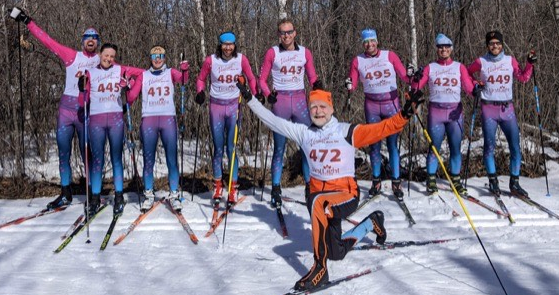
Vakava Team Photo

Vakava Team Photo
Vakava Racers at the Mora Last Chance Race

Sunday, December 13, 2020

Training Block Trial

I’ve previously noted that my results seem quite stagnant. I made a joke recently about always being 17th in the City of Lakes Loppet Skate Race. Indeed, when I looked up my 2020 results, I was 17th.

There’s one thing I’ve never formally done with my training and that’s periodization. Sure, I’ve had some natural periodization over the years, but I’ve never trained in purposeful blocks.

This can be really hard to do with a 40 hour work week and that’s been my excuse in the past but after returning from the Boundary Waters and having a couple 5 day weekends in October, I decided to give this idea of training blocks a try.

The other reason I haven’t done these intense training blocks is that I’ve been afraid to bury myself. There have been a couple periods in my life when I was overtrained and these were completely awful. My response was initially to not do any speed work. As I’ve added back in speed work, I’ve always been careful to not do too much. But in not pushing my limit, building up and resting, building up and resting, I’ve been losing out on this building up and as a result haven’t gotten faster or stronger.

So I tried a couple training blocks, tried to bury myself, and see what happened.


Block One: 

After a rest week (technically week 1) in the Boundary Waters (not that I wasn’t averaging 20 miles a day of paddling and portaging) I decided to do three consecutive weeks of increasing hours. My typical training week is about 12 hours for reference.

Week 1: Canoeing and portaging in the boundary waters with two additional runs.

Paddling in the Boundary Waters


Week 2: Goal hours: 15 (actual 14.4); goal interval sessions: 3 (actual 2)

I had some difficulty getting in all my hours. Looking back this seems a little ridiculous but I wasn’t yet in the mindset of getting in hours. I’ll also make the excuse that with it getting darker earlier, I had less time after work to squeeze in an extra roller ski.


Week 3: Goal hours: 17.5 (actual 17.65); goal interval session: 3 (actual 3)

By now I was more into the idea of getting in hours. I still wasn't tired, even with 3 interval sessions, which seemed a bit weird. Maybe it was because my sprint interval session didn’t feel very “sprint-like.” I just couldn’t find my sprinting gear that day- not that I ever really “sprint” but at least go fast for me. Maybe it was because I was more tired than I thought:).


Week 4: Goal hours: 20 (actual 19.1); goal interval sessions: 3 (actual 2)

I skipped my “sprint” interval session because I was tired and didn’t think I could do it effectively. Finally I got into the groove of getting in the hours. At the same time, I decided to take a two week hiatus from running to see if I could get a foot injury to heal (or at least for the swelling to resolve). Instead I biked more. Despite a 19.1 hour training week, after two higher than average volume weeks, I still didn’t feel tired- maybe because I did more biking than running? My last session of the week did make me pretty tired- a 3.5 hour, 32 mile roller ski, some of which I skied with some of my speedy guy teammates. After that I still needed another hour for the week. I had planned to bike but Erik was diligently working on fixing up our garage, I was intermittently helping, and thought if I did anything it should be to rake some leaves. Overall it didn’t seem like I’d get much out of an hour bike ride and so I helped Erik and raked the leaves. Only high caliber cross-country skiers don’t count leaf raking as actual exercise:)


So how did block one go? Well, I don’t think I could have done this without a couple extra days off from work. Overall I was surprised that the high volume weeks didn’t kick my ass, but likely because I wasn’t doing much intensity and perhaps because I wasn’t running much.


Long Afton rollerski

Block Two: 

With daylight savings time and decreased daylight, I figured that three weeks of increasing volume would be a sure way to bail on the block so instead I chose a different approach I think I got from reading something by Tara Geraghty-Moats: one week of high volume, one week of frequent intensity, and one week of high volume strength. So after a “rest” week of my approximately normal hours, I was ready to start ramping up again.


Week 1: Recovery

I can’t say I needed too much, or really any, recovery time from the previous training block. Again, likely because I didn’t do much running or high-quality intensity. Or am I really that well trained???? The whole point of this is to work myself hard. Hmmmm….


Week 2: Goal: high-volume, 20 hours (actual 20); goal interval sessions: 2 (actual 1)

I snuck this in again on a week where I had one day off and before daylight savings time. Unfortunately this was also the week where the weather flipped and we got 5 inches of snow. Despite this, I was pretty determined to get my hours in which meant a fair bit of roller skiing while there was snow on the ground. Often the skiing isn’t so good when the ground isn’t frozen and so I just opted for roller skiing.

Our weekly Vakava interval session was cancelled due to too much snow to roller ski or hill bound but not enough to ski. Dave cancels practice like once every two years for weather extremes and this happened to be one of them. I ended up roller skiing by myself from my home on city streets and didn’t have the motivation to do any intervals.

This is what determination looks like


I roller skied four days in a row despite snow on the streets, bike paths, and grass. I ran and roller skied in the rain and snow. It was dismal weather, but I was quite determined. The focus became on getting in hours and when I made this a priority, I got it done. I will say that I am proud of myself for those 20 hours!


Boo-ya! This is a snippet from my 20 hour training week!


Week 3: Intensity

I didn’t know exactly what this week would look like. Leading up to it, I didn’t have the time to make a good plan. I figured I should do 4-5 interval sessions this week and ideally do two interval sessions in one day with a mix of L3, L4, and L5 intervals. I didn’t set myself up terribly well for this week because I did intervals the day before this week began.

My first day of the week, a Sunday, I was amazed at how much I could get done (Christmas letter, blog post, cleaning) when I only trained for 1.25 hours since I was no longer on my high volume week!

Some days I feel more on and other days more off. My last few attempted sprint sessions on roller skis I didn’t feel as peppy as I wanted. I vowed to make my first intervals of the week- classic roller ski sprints- highly energized. I’ll admit I almost wanted to give up when one of my ratchets broke early on in the roller ski. Instead I told myself to use this to my advantage to do double pole only. And I did and had a great workout- both working on super high tempo double pole and slower but stronger double pole on some decent uphills. And I threw in a few on the flats which felt good, too. It also helped that Erik has been diligent as of late to keep our roller ski poles nice and sharp. This makes a huge difference, at least for me.

Two days later I took the opportunity to double up on intervals. I ran 30 minutes of consecutive Level 3 on my way to work, then followed that up in the evening with Level 4 classic roller ski intervals with Vakava. I didn’t go quite as fast as I was hoping at Vakava but don’t think that was necessarily due to the morning interval session.

After this double interval day I fell off the bandwagon. I really should have done more intervals on Friday or Saturday but we had a planned Vakava 5 km skate followed by 5 km classic roller ski time trial slated for Sunday. This meant that although I would only be doing three interval sessions during my “intensity” week, I would do five interval sessions over nine days. Then our time trial got called off due to cold weather. I really should have done another interval session on Saturday but just didn’t have the motivation to do it:(

I’ll add here that my week 3 training time was just 11.7 hours.

So I didn’t get in many sessions, but I did do a double interval day and vow to do better next time so I’m giving myself a break:)

Getting my dolly, Molly, all ready for Halloween!

Week 4: Strength

Leading up to this week, I had been rocking the strength including loads of pull-ups and even weighted pull-ups. I was feeling strong but by the time I hit this week, I had some right shoulder pain that decreased my motivation. I also had never done a “strength” week before and didn’t know what this would look like other than more strength volume and doing a strength workout on roller skis.

Prior to starting these training blocks, I never diligently kept track of my time doing strength and just kind of guestimated. Once I entered my training blocks and high volume weeks, I tried to remember to look at the clock. My guestimates left me with about 0.9 hours of strength per week. This clearly isn’t much but consider this is all “on” time as I do circuit strength with abs, push-ups, pull-ups, squats, and step-ups, some of it with additional weight. Once I paid attention to actual strength time, my guestimates were likely under estimates.

In my first training block, in weeks 2-4 I did 1.1, 1.85, and then 2.15 hours of strength. During the high volume 2nd week of block 2, I did 2.25 hours of strength. In my “Intensity week” I did 1.4 hours and during my “Strength” week I did a dismal 1.2 hours; however, this is largely because I skipped my strength workout session on the last day of the week as I was tired from 5 km skate and classic roller ski time trials and the next day, what typically should have been my “off day,” we did strength on roller skis with Vakava.

I trained 13.5 hours the “Strength” week.

Again, I didn’t have a clearly defined goal but it’s safe to say my “Strength” week should probably have been closer to 3 hours based on previous weeks and I was nowhere near that.

Summary 

This was an interesting experiment. It’s crazy how hard it was for me to hit 15 hours when I first started and yet how relatively easy it was to hit 20 hours when I tried harder. I will say the 20 hours was obsessive. I think I’d only go for 20 hours again if I was on a ski trip. The 20 hours at home, even with an extra day off from work, was way too contrived.

So if I did volume again, I’d probably build up with 14, 16, and 18 hours, or maybe even just 14, 15, and 16 hours. Based on adding in some more strength training this year, I think my biggest bang for my buck would come with more time doing intervals and strength. In other words, more high-quality sessions.

Will I do more training blocks in the future? I think yes. It doesn’t seem fun to do these continuously like the professional athletes do, but seems realistic to do a few blocks per year.

For now I’m giving myself a break as shoulder season mostly keeps throwing me the cold shoulder between snow that really isn’t skiable but makes the roller skiing difficult, my ongoing foot issue, and a persnickety shoulder. But, as I look towards holiday vacation time, I’m thinking about doing another couple training blocks. Stay tuned...


Getting the house all ready for the holidays

Thursday, November 5, 2020

I FINALLY DID IT!!! A TALE OF BUTS AND THE MAKING OF A MEMOIR

Back in 2004, I was a burgeoning cross-country ski racer. Fresh off my first ski marathons, I was inspired by my college club teammates with their head-turning names and finish places. Waiting for me when I arrived home from my freshman year of college was Pete Vordenberg’s newly minted Chasing the Olympic Dream, a gift from my mom. Wow, I was ready for a summer of ski training.

But there was one more thing I wanted to do, and that was write. For years I’d put pen to paper, or finger to keyboard, but I’d yet to produce anything solid. Reading Pete’s page-turning book about him careening down a mountain at 55 miles an hour on roller skis and streaking naked across a stage at his college made an impression on me. I was ravenous to read more books like Pete’s. The problem was, there weren’t any. Wow, I could write a book about this summer in training!

But not quite yet.

Three years and a few character-building life experiences later, I penned an outline for a memoir. Over the next decade I wrote, and then painstakingly edited what was initially a 155 page single spaced manuscript.

I thought I had the perfect ending, something that happened when I was 27; but the real ending came when I was 31. It turns out that writing, just like life, can’t be forced.

All the while, I knew this whole publishing thing was looming on the horizon. It wasn’t really something I wanted to think about. Writing my book was the easy part. Publishing was the impossible part and totally out of my control. And I don’t do well with things out of my control.

And so, after a decade, I was ready to submit to publishers. Or was I?

See, the thing about a memoir, is that it’s incredibly private and personal. Sure, there are parts that lots of people already know about and that I don’t really care if people know about me. But there were other parts I wasn’t really sure I wanted to make public. Yet, for that decade, the goal, the purpose, was always to publish.

I sought a small outdoor publisher where I thought I had a decent chance. I spent several months tweaking my query letter, writing a synopsis, a chapter outline, and even a market analysis. I waited patiently for almost a year for that first rejection. I won’t lie, it hurt and took a while to rebound. I submitted to a handful more publishers over the next few months. I really wasn’t interested in self-publishing but several rejections later, self-publishing became the obvious thing to do. I simply didn’t think I had the time to keep finding and submitting to publishers with the same end result: rejection. It was amazing to me how successful I could be in many domains of my life and yet what a complete failure I could be at publishing my book.

So I decided to self-publish. I set a launch deadline and set out to edit my book for One. Last. Final. Time. I truly vowed that this was the absolute last time I could edit my book before I turned it over to a couple editors to get me a nice looking project. “Elspeth, remove the jankiness,” I told myself. Janky became my word of 2019.

And so I was in the midst of this final edit before selecting a self-publishing company when I learned Jessie Diggins was about to launch her book. To say this was one of the most disappointing days of my 30s would be an understatement. All the self-doubt and self-unworthiness flooded into my mind. Elspeth, just give up now and save yourself the 10 grand to self-publish. No one wants to read your stupid book anyway. You’re just a dumb copycat.

I’m never going to win an Olympic medal. Heck, I’m never even going to the Olympics. But I was going to write the book on being a female cross-country skier. And now I had failed at this, too. Worse yet, I got rejected by the same publisher that took on Jessie’s book.

It would be so easy to just quit now. To just leave the document on my computer. To keep the private things private. To stop editing. To not find the self-publishing company. To not edit the book with the publisher. To not fork over the dough to publish my book. To not advertise my book.

But I’m not a quitter.

But I wrote this book to get it published.

But my last chapter is called “Epitomizing Determination.”

But I want to validate others and help break the silence on the mental aspects of endurance sports, especially for our high school athletes.

But even though I’m not famous and don’t want to be anyway, my story deserves to be heard.

But...but...but...maybe this will be the biggest failure of my life. But I won’t know if I don’t try. It’s so much easier to say my mantra to someone else, but sometimes I have to say it to myself, too: sometimes we have to fail to succeed.

Our car full of 1,040 copies of my book! If I don't succeed, one of these copies will be coming to a Little Free Library near you!!!

So I wrote a book. A memoir at that. This is the before-story to my blog, if you will. It’s about my childhood and how I got into running and skiing. It’s not perfect but I couldn’t edit it forever. Some of my critiques say I write as well as Cheryl Strayed in Wild, but spoiler alert, there’s not enough sex or drugs to truly compare. But it’s not a pretty book. As a memoir there’s some skeletons that come out of the closet.

And the crazy thing is how good I feel about this self-publishing process. This was the right thing to do. Copyright 2020 couldn’t look better. And I got to collaborate with my mom on the most beautiful cover and subtitle. It's amazing how it all came together. I can’t thank my mom enough. It’s perfection! 


To buy:

Amazon

Or support your local ski shop:

Finn Sisu

Pioneer Midwest

Gear West

Home Place

Or find me on your local ski trail this winter and I can autograph a copy for you!

Thursday, October 8, 2020

Vakava Fall Camp in the Time of COVID

One of my favorite weekends of the year is always our Vakava Racing Team’s Fall Camp up in the Hayward/Cable area.  This would be our 16th annual, but several months ago I was not at all confident that we were going to be able to pull it off in this year of COVID.  The training part of the weekend has always been outdoors and thus would still be relatively safe, but we’ve always crowded ourselves into a couple of our members’ cabins for the eating and sleeping parts.  Further, I know that some people are having a hard time getting fired up about doing any serious training in a year when the upcoming racing season is so uncertain. 

But other team members and I have talked about this, and, to the contrary, that possibility of a diminished racing season hasn’t really affected our training at all.  We certainly hope for good racing this year, but we don’t train just to get in shape for racing.  Getting outdoors, working hard, training most every day of the week is something that is just part of what we do, part of who we are.  We love to ski, we love to train, we love to -- and hope to -- race.

So, let’s do it.  Why not make it an actual camping camp, completely outdoors, with people in individual tents, cooking outside, and sitting around the campfire in the evening?  And indeed, this first weekend in October we packed up all our gear and the Vakava Team headed for the north woods.

Birkie Trail -- leaves instead of snow
Our schedule was pretty much the same as it has been for a number of years. Started off Friday afternoon on the Birkie Trail with an hour-and-a-half run for part of the group, a brisk pole-hike for the rest.  It’s a different look with the brilliant colors of autumn, and you even get to stop once in a while and enjoy the view, but it’s the same great trail with all those hills as it is when you’re racing in the winter.

Afterwards, as usual it was up to The Rivers Eatery in downtown Cable, where Beth and Mick Endersbe serve up some of the best pizza and beer around.  I know, anything goes in Wisconsin right now, but the Endersbes are being properly cautious about our and their safety; ordering is online, and we enjoyed our meal on their outdoor patio, sitting around a cozy bonfire.  If you haven’t been there, you really need to check this place out the next time you’re up in Birkieland.

Saturday morning it’s always classic roller ski intervals.  This year it was on the smooth pavement and gradual climbs of Mosquito Brook Road just south of the Birkie Trail.  Over the last several years we’ve settled on a double, descending ladder: 6 minutes, 6 minutes, 5 minutes, 5 minutes, etc., down to two 1 minuters.  That’s 42 minutes of on-time, getting steadily faster and more intense, with the last ones being absolutely flat out.  A butt-kicker of a workout.  (P.S. Don’t do this one every day.)

The Vakava Racing Team, with our classic Marwes.  (World’s best roller skis; you know where to get them.)

Back for lunch at the big, open field at the Porath cabin where we camped, and, after a bit of a break, an afternoon strength session with body-weight and core exercises.  Finally, dinner and then relaxing around the campfire with a well-deserved beer or two.

Woke up bright and early the next morning to a frosty but sunny 22-degrees -- felt great, we’re winter people -- and got ready for our final session of the weekend.  Sunday morning is always a long, 3-plus hour skate roller ski, nice and easy, interspersed with fast, 20-second pickups.  We’ve usually skied from Cable to Drummond and back, but this year we stayed farther south on Upper-A, east of Double-O.  Perfect, rolling terrain, good roads with little traffic, and absolutely beautiful, with the crisp air, bright sun, and bright fall colors right at their peak.


I always tell the team that this is going to be -- and is supposed to be -- a hard weekend and that everyone's going to come home tired.  We did.  Pleasantly fatigued.  A weekend in the north woods with great weather and fall colors, great training, and great company.  Pretty hard to beat.  Especially in this, our year of COVID.

Friday, September 4, 2020

Long-Term Goals

In this year of unknowns thanks to COVID-19, it’s hard to know for what I’m training. Sure, there is the ski season, but we don’t know if that will be normal or not. As time progresses, it’s getting more likely that events will be more like individual time trials.

I’ve been thinking about my goals as I run 200s on the track, thinking about breaking a 6-minute mile while also tinkering with the idea of running an ultra-marathon in the fall, and then there is always skiing. So I started to think about my training in general and came up with this list of long-term (if not life-long) goals.


1. I want to be able to walk fast, run, squat, jump, ski, climb mountains, canoe, and still do some pull-ups when I’m in my 70s. And I want to be able to do this mostly pain-free. While this may not be at my current level, I still want to be able to do these things.
 

There are lots of exemplary people I know who are able to do these activities into their 50s, 60s, and 70s. I wish I could be as spry as Ahvo is in his 70s, but I don’t think I was that spry at age 3 so he may not be a good example- but maybe I can still jump and run in my 70s. To achieve this goal, it’s important to look at what I’m doing now. Simply being active and doing these things now can help me maintain this goal in the future. I need to continue doing these things to maintain a good fitness base and strength throughout my life. This means paying attention to what is hurting me now and doing physical therapy to prevent the minor things from turning into major things. It also means not overdoing it to cause injuries.

Ahvo, sporting his Yoko get-up in Finland's Border-to-Border tour


But I also need to consider agility and balance. These are things that are not natural for me. I try to do some stretching but always think about doing yoga. People tell me this is good to do. Maybe one of these years (when I stop working so much), I’ll start getting in the habit of doing yoga. For now, I’ll at least keep doing crow pose.


2. I want to ski fast for many years to come, whether it’s racing a sprint or a marathon. I don’t have a specific age for this. It used to seem 50 was the end age, but then there’s local women like Jan and Kate and my teammates Marybeth and Bonnie who are proving this is possible until at least age 60. Then there’s Dave, he just turned 70 and man, but is he ever fast and still hungry to push himself. With climate change it’s impossible to know if we’ll still be ski racing in 35 years, but I do hope I can still push my body and be brave then. Dave is a great example of the “use it or lose it” principle. I don’t think I’ll be roller skiing in the dark when I’m 70 (I largely try to avoid this now). Of course, with global warming, it’s possible that may define my age limit.

Kate kicking [my] butt at the Mora Vasaloppet in 2017
Bonnie skiing so fast at this year's Birkie.
Arguably not Dave's best moment- but I've put in this picture because he's willing to take risks to be competitive now into his 70s! He doesn't ski like he's 70.
 

So I keep up the roller skiing, strength, and general ski training. I’m not satisfied yet with my previous ski results. I want to see if I can crack into that top 10 in the Birkie Classic, keep up with Josie in the Mora Vasaloppet, and get a PR on our 1 km double pole roller ski time trial course. It’s also important for me to make some changes to my training given it seems my ski performance has been relatively flat the past few years. I’ve made some changes to my strength training (more to come soon) and am thinking more about planned periodization (maybe more to come at some point). Of course, I’m always working on my technique as well. While I may never achieve the above specific goals, it’s even more unlikely that I would achieve them if I didn’t have them.

Still skiing with Josie early on in the Mora Vasaloppet in 2016. Maybe some year I can stay with her!


3.  I want to run fast. Specifically, I still want to sprint, I still want to break a 6-minute mile, and I still want to race a fast half marathon. Last year I took a hiatus from running races after I got injured in the midst of training for a 5 K and focused more on ski training. This year I was determined to train again to break a 6-minute mile. I did a baseline mile in 6:44. Then I started doing intervals but will admit I was discouraged when I could barely hit 200s at 6-minute pace. This has taught me I need to go back to basics and work on running form and even sprinting. I’m also interested in trying another PR 5 K. To some extent, mentally I can only handle so many really fast running intervals, especially on early weekend mornings. Then there is running fast at longer distances which is more my forte. I’ve never even ran a road half marathon! I don’t have much desire to try for another marathon PR, but I do need to get after that half marathon at some point. I don’t necessarily have a goal time in mind for a half marathon, but I do know my pace should be faster than 7:56 which is what I did for a 16.7 mile race three years ago that seemed to push me to my absolute limit. So for these different distances, I need to set a goal race, train for the goal race, and then get a PR. 

With these future running goals in mind, I’ve done everything from 200s to 15 minute tempo/L3 runs so far this year. It’s good ski training and will keep my legs fast for those future goal running races.

I've been chasing the 6-minute mile for 19 years now- training on two continents and lots of different states!
 

                                                            ___________________________

If there’s anything that I’ve learned over the years, it’s to celebrate achieving goals! This is especially true because it can be daunting to set a goal I can’t achieve until I’m 70. Some goals are really small, like daily to-do lists, some take months, and some take years. So I’m going to celebrate my recent completed goals:

At age 35, I’ve finally learned how to french braid hair!

After a couple months of french braiding my own hair, this was my first go-round on someone else's...and I think it's pretty darn good for a first try!


I’m ridiculously proud of this pot that I planted this spring. It’s partner (on the other side of the door stoop) didn’t turn out quite so good. But this one is perfection!

The front planter that turned out perfect!


And…

drum roll please…I’m launching my own website featuring a new blog about all my adventures!!!