
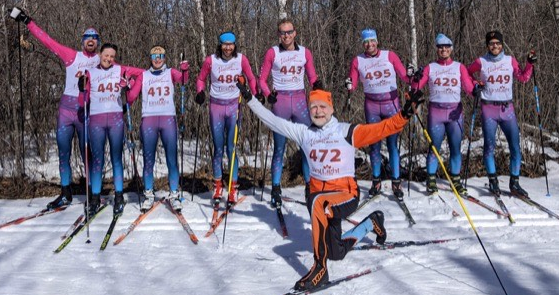
Vakava Team Photo

Vakava Team Photo
Vakava Racers at the Mora Last Chance Race

Saturday, December 4, 2021

Training Analysis Part Four: What Can Garmin Connect Tell Me?

After an almost two year hiatus (turns out publishing a book got in the way), I’m back with more analysis from my training log. This time, I’m going to see what the Garmin Connect website can do, pulling from years of my data going back to 2011. Note, I don’t always use my Garmin, especially for easy biking and running to and from work. Otherwise I use it for most workouts and all races.

I’ve had the Garmin 220 since late 2015 and prior to that the Garmin 210 that Erik got me for Christmas in 2010.

I should also establish that the principle three questions in analyzing my training log data are (1) what training makes me ski/run faster? (2) what training makes me ski/run slower? (3) what training is neutral?

It took me a tad to search through the left sidebar of the Garmin Connect website to find meaningful data, but then I happened on the “Reports” tab. On the “Reports” page, on the left side under “Reports” there’s a bunch of things to click on that are then displayed on a graph on the right. The graph on the right can then be changed to "7 days," "4 weeks," "6 months," or "1 year."


This graph shows my average heart rate per activity from January 26, 2020 to February 22, 2020. The high points correspond to the City of Lakes Loppet Classic Marathon, City of Lakes Loppet Skate Marathon, Mora Vasaloppet 42 km Classic, Minnesota Finlandia 25 km Classic, and Birkie 50 km Skate.


From here under “All Activities” I found “Total Activity Time” and “Total Distance” that generated some nice bar graphs representing my different activities for the year. 


This bar graph shows my total activity time in 2015, when I ran the Twin Cities Marathon. "Other" is mostly rollerskiing. This year we did a Thanksgiving ski trip to Colorado.

 
Here's my total activity time from this year when I didn't run a marathon.

 
For comparison to total time, this was my total distance in 2015. My August is lower because both year (2015 and 2021) I went on a backpacking trip and did not use my Garmin.

 
And 2021 total distance where I did a lot of rollerskiing in October!


Moving farther down the Reports on the left, if I clicked “Running” it opened up a new drop down menu that told me information about just my running workouts such as “Average Heart Rate” and “Total Distance.”


This graph shows my average heart rate for running only activities in September of this year with the one high value being the City of Lakes Half Marathon.


At the bottom of the “Reports” menu is “Progress Summary.” Clicking on this opens up a new page where I got most of my data. The first view that pops up tells me the number of all my recorded activities, distance, and time spent doing them. It was definitely a bit mind boggling to learned I’d entered almost 25,000 miles of human powered activities into Garmin Connect! Still, this info wasn’t terribly helpful so I kept searching through the different drop down menu options. I most liked to “Group by Year” under the “Progress Summary” option and then pick my activity. Doing this I generated a bunch of data. Note, the fields displayed can be customized on the right side. It’s also possible to customize dates. 


This is the default page that opens for the "Progress Summary." If you've never been here, it will likely blow your mind if you have much data. At the time I took this snip, I'd entered 2200 activities for over 24,000 miles in 3,687 hours climbing over a million feet of elevation gain! Quite the "wow" factor. Not terribly useful data other than something to remember on Bitch Hill.


Grouping by year, this shows the above data broken down annually.

 
Here's running by year.

 
Rollerskiing by year. Again, wow, over 6,500 miles of rollerskiing!

 
Classic skiing by year.

 
And skate skiing by year.

The only other useful left menu option I found is the “Activities.” By going to this tab and loading all my activities, I can quickly check average heart rates for races by searching for specific activity and under "Advanced Settings" choosing “Race” then “Filter Activities.” 

Here I've filtered to find just my skate ski races.


The best I could get for looking at my intensity or interval training is at the bottom of each specific activity where there’s a tab on the left for “Time in Zones” (this is next to “Stats” and “Laps”) which can show me my time in the different training zones for that specific workout only. There is no way in Garmin that I, or Erik, could find to analyze the intensity/interval training across different workouts or years. 

Heart rate zones for a recent L4 (5 x 3 minutes) classic ski interval workout I did at ABR that also included a couple hours of easy skiing.


It turns out I’m a bit of a data geek- not surprising given I always liked math. There was something about analyzing this data that was addicting. Even if I didn’t arrive at any great conclusions, the point of this exercise was to explore the Garmin Connect website and see what I could find.

But what I’m really looking for is to compare my time spent doing intervals and heart rates with race results. I should clarify that the most useful information I could get from Garmin Connect would tell me how to ideally train for my best race possible. Unfortunately the system just isn’t set up to compute this data.

Erik tells me I’d have to export my data to Strava, Runalyze, or TrainingPeaks and since that’s beyond the scope of this post, stay tuned!

Sunday, October 17, 2021

City of Lakes Half Marathon

Back in June, Erik declared he needed a race to provide some motivation. After debating some adventure and trail running races, we settled on the City of Lakes Half Marathon, which I argued could provide more specific goals than the unknowns that come with trail. 

Despite running the Loppet Trail Half Marathon a few times, a 26 km race around Lake Bemidji, and two marathons, this would be my first road half marathon. My pace for the 26 km race had been 7:56, so naturally I wanted to go for 7:50 for the half; however, that 26 km race may have been my best distance race ever and it was four years ago. After doing a couple threshold runs, 7:50 pace seemed too ambitious. Maybe a couple years of injuries and not doing much fast running has made me slow. I had some hopes that a week at altitude and Level 4 uphill running intervals would give me a boost but not so much luck. 

Finally the week before the half I did a new workout that I made up: 3 minutes and 30 seconds at 8:00 mile pace followed by 30 seconds of recovery jogging for an hour (15 reps total). The first 10 of these felt amazing, then #11 I increased my pace accidentally and the second half was uphill and by the end I was in Level 4. When I started #12 I was a bit dizzy but finished, possibly because then I was running downhill. #13 was another uphill and by half way through I was 2:1 breathing and my body was doing the thing where I feel like I needed to have explosive diarrhea (i.e. I was hitting my max). I stopped and walked, then rallied for numbers 14 and 15, hitting both at just under 8:00 pace. 

My heart rate for the 3:30 on 30 seconds off until I hit the wall (excuse the artifact at the beginning that always happens with my arm strap).

Looking back at my splits, I hit the wall after a few too many sub 8:00 paces in a row, so that told me I better aim higher than that for the marathon and decided to even go a bit conservative with 8:20 pace and then hopefully pick it up near the end. 

Race morning dawned moderate temp for September, cloudy, and maybe a touch humid (i.e. 60 degrees). The course, almost two laps around Lake Harriet and Bde Maka Ska, initially seemed a bit boring to me, but then I realized it doesn’t really matter much where I race and sometimes loops are nice. Erik’s training hadn’t gone particularly well after he got “dysentery” on our backpacking trip last month, and he was hoping to not get wified which meant he mostly planned to run with me. 

The race definitely has a large field. It felt a bit unnerving given the recent surge in COVID-19 cases. I kept a mask on in the port-a-potty line and for awhile in the starting gate. Erik and I started relatively near the front but not too close. When the gun went off it was a bit of a traffic jam. Just chill, Elspeth. We’re probably going faster than I think. And every second I run slower now are seconds faster I will run later. 

Less than a half mile into the course it climbs a hill on the south side of Lake Harriet. This was good to string out the runners. As we made our way along the east side of Lake Harried the course was fairly packed.There was plenty of room for people to pass, but there were a good number of people around me. I tried to keep things in control and not go with anyone passing me. My splits were mostly on target. It was still easy. 

City of Lakes Half Marathon course per my Garmin. Note the start (green arrow) at Baird's Plaisance is not where it finishes (red square) at the Lake Harriet Bandshell- so it's not quite two loops.

I ran a bit fast up the hill between Lake Harriet and Bde Maka Ska but then reeled things in. There was another hill on the east side of Bde Maka Ska that I didn’t know about. We ran in a lane on Lake Street on the north side of Bde Maka Ska. A woman passed me wearing a tie-die t-shirt with wolves on it. I wondered if it was cotton. It wasn’t exactly form fitting but despite her shirt, this woman was cruising! It reminded me of a guy who had passed me early on wearing a singlet with a tree pattern- probably the prettiest singlet I’ve ever seen. It’s interesting how people wear different clothing and it doesn’t always match their speed. 

We got cross wind on the southwest side of Bde Maka Ska that became a headwind as we turned east. I ducked behind a couple guys to draft off them. It’s not something I usually do running but it worked. As we turned to go back towards Lake Harriet there was a two-way section and Erik and I were both a bit stunned by the fastest runners who were already heading back to Bde Maka Ska. Soon we were through the lap/finish and going back around Lake Harriet. 

As we climbed the hill on the south side of Lake Harriet I tried to keep things in check but couldn’t help noting the women in front of me that seemed to be slowing. Let’s race. It’s time to catch the women, I thought at mile 8. By now I was starting to breathe a little harder. I still felt good, but there were also still 5 miles left. I passed a couple of women and then we were back on the two-way section. The top runners were lapping a lot of runners. The woman I had been running with for the past couple miles pulled ahead of me along with another guy. I took a gel at the top of the hill on the east side of Bde Maka Ska, arguably as Erik would later say, a bit late in the race. 

Then we were down the hill, back on to the closed lane of Lake Street, going up the rise over the canal, then flat, zoning in on mile 11. My plan here had been to speed up if I felt good but I knew I was already running under pace and only had at max two sub-8 minute miles in me. All I could do was maintain. 

I came through mile 11. Let’s go hunting. Not many women in my sights though- not many men either. Everyone was really spread out. I didn’t feel like pushing much faster. I was working hard and the next mile flew by. One mile left. By now I was closing in on two women. It seemed it was taking forever to pass them. Erik moved in front of me. I stuck on him. Slowly we passed the women. The wind wasn’t as strong this lap around Bde Maka Ska. 

The last half mile droned on forever. I resisted the urge to look at my watch to see the tenths of a mile pass by. We turned onto the two-way between the lakes. I moved alongside Erik. Slower runners were coming in the opposite direction. I pushed hard up the hill. Erik and I were tied. There was a brief plateau, then more climbing. Elspeth, remember how you feel now, I’m giving this all I can. Then we were over the hump, made a sharp right turn, then gradual downhill to the finish. I pushed what I could and Erik and I crossed the finish line together. 

After finishing we walked towards the food tent. I got the chills and the feeling that I had to poop. It was brief but meant I’d finished hard. 

My time was 1:47:12 for 8:12 mile pace which was about the best I thought I could do based on my training. Obviously not the 7:50 pace I was initially hoping for, but still decent for me. I know I have a higher gear, but it didn’t come out to play and that’s OK. My average heart rate was 152 with a max of 167. And I finished 70th of 357 women! 

My nice heart rate graph, slowly increasing, for the half marathon.

For now I’ll go back to the ski training but next year I’ll set my sights on some more running and hopefully no injuries. 

Aside from the half marathon, my training this year has been woefully inadequate. Most weeks I’ve been averaging just under 12 hours, the amount I consider my baseline. After a backpacking trip in Yosemite at the end of September, I’m determined to average at least 12 hours/week of training for October and November, if not even more. My long Sunday rollerskis all need to be at least 2.5 hours. Time to start hill bounding!

Tuesday, September 14, 2021

Strength Reboot

Not unlike many of my posts, this one has been over a year in the making. I’ve held off publishing it until I found a solid strength routine and gone through an entire cycle.

Andy Newell, in his interview with Ian Harvey
, says the biggest mistake skiers make is doing the same strength routine. He says don’t do the same routine for more than 5-6 weeks. He recommends periodization and mixing up the exercises. He also talks about velocity strength. He says that if you aren’t getting faster you need to do something different in the gym.

While I’m good at doing strength three days a week, I’m not good at variety or progression. This is partly because I can do 10 pull-ups which is super kick-ass for a 36 year old woman and I can do the 8 minute ab routine easily and even my 12 minute side-ab routine is getting easier. I keep trying to substitute in different ab exercises and routines, but after a few weeks or months, they all get too easy.

But despite this, I feel weak.

You might be wondering how I can do 10 pull-ups and feel weak but it’s because I haven’t really progressed in the past 8 years or so. I mean, I’ve progressed a bit- I used to do 5 reps and now I’m up to 8, but that's hardly any improvement.

So my strength training needed a reboot.

I began developing a plan last year and tried some things out and this year have made a more complete plan with 3 main goals:


1. Increase variety (do different exercises)

2. Lift with weight more 

3. Progression (i.e. start w/ body weight and then progress to adding weight)

My plan is still to do strength three times a week, each for about 30 minutes rotating through 4 week blocks of progression.

So let’s talk about these different goals.

In terms of variety, I don’t have much fancy equipment at home. Currently I have a pull-up bar, a Total Gym, two 10-pound dumbbells, and some resistance bands. For years I’ve been doing push-ups and pull-ups but as I’ve created a plan, I’ve found that there are a ton of variety options just with push-ups and pull-ups alone. For both, arm position makes a big difference. There’s also different speed and hold options. For example, my push-up planks I hold in high position for 5 seconds, then do 5 push-ups, then repeat until exhaustion. I also do both push-up and pull-up holds whereby I go partway up/down, hold for 5 seconds, go all the way and hold for 5 seconds, and then hold for 5 seconds part way up/down again.

Our Total Gym, some posters for inspiration, and a messy basement:)

Until last year I never did my exercises with extra weight. I brought in weighted pull-ups and then started doing squats with weight. This year I’ve added in weighted stair steps. For the legs it’s not a ton of weight. This will likely increase when we finally buy some heavier dumbbells, but until then, it’s at least a start.

Finally, I developed a 4 week progression working backwards from ski season with a rapid fire in January of one week each. The idea is to do a weight progression followed by a velocity/speed block. This is also to help with developing my power.

My pull-up bar and more posters.

Prior to doing my strength sessions, I like to do a warm-up. Sometimes this is running or biking home from work but my favorite is a 30 minute classic rollerski.

My plan is still a work in progress. I’ve been using Youtube ab workouts to give me some new ideas and I’ve found some hard ones I can’t quite complete! I try not to worry too much if I miss a day of strength (like if I’m building a retaining wall or on an active vacation).

Retaining wall to bust out. This stuff was heavy!

Active vacation in the North Wind River Range in Wyoming.


So here’s my plan. Use what suits you or simply read for interest. 

Overall plan.


More detailed plan. I don't have reps or sets on most of these noted. For push-ups I usually do 2 or 3 sets of 20-30 push-ups, trying to get low enough to get my nose (is that gross?) on the ground. Pull-ups without weight is usually 8-10 on my first set and 6 or 7 on my second set. With weight it's 5-4-4 or so for both sets. I do 20 step-ups (2-3 sets each leg) and 20 squats (1 set each leg position).  

My four different pull-up grips.

Leg exercises including my four squat positions.


A detail of my different ab routines minus the YouTube ones.


My three YouTube ab routines:

6 minutes: https://www.youtube.com/watch?v=3M3W5VCsuCY

10 minute lower abs (this one is a killer): https://www.youtube.com/watch?v=54x6yjnzLms&t=303s

10 minute 6-pack abs (good luck!): https://www.youtube.com/watch?v=vOiP3kfFlrE 

I usually do all my abs at once but will alternate an upper body with lower body set so as to not have any “resting” time between sets. If I find I need more rest between sets, I will throw in some physical therapy-type exercises or striding or skating mimic.

Often I do 3 sets of exercises, except I usually do 2 sets for each pull-up grip and 1 set for each squat position.

I realize this plan is heavy on pull-ups for upper body and most people can't do pull-ups with weight. This is the equipment I have and what I've been working with. And while my pull-ups may seem impressive, in my experience, there's only a very minor correlation with ski performance.

Caitlin says "Do Your Pull-ups!"


It took me until I worked through an entire cycle of this plan before I could publish this blog. That way I was able to find the exercises that work for me, and even the ones I found most fun. Jump lunges were initially in the plan but they seemed to hurt my foot and didn’t feel good so I threw them out. Meanwhile I found jumping w/ tucking my legs up to be really fun so I incorporated those. I wasn't able to be very explosive on the pull-ups during the Velocity phase so next time around I will substitute one pull-ups session for inverse push-ups (pull self up to a very low bar with body almost horizontal) and pole jumps (use bounding poles to get self high into the air).

I find the 4 week (or month-long) block to be about the best duration for me to get some progression but not get too bored. If I stretch it out to 6 weeks it feels too long. In the future I may try more rapid cycling with 2 week blocks (although it’s easier to think in terms of months) or perhaps do a full cycle each 4 weeks followed by 2 week blocks.

This new strength plan may or may not make me a faster skier, and I’m OK with that. The point is to do something different, something that’s fun, and something that makes me happy!


Tuesday, April 27, 2021

2020-2021 Season Recap

 The Year of the Skiathlon COVID-19


When Governor Walz closed all non-essential businesses for two weeks in March of 2020 due to the COVID-19 pandemic, I knew the pandemic would last much longer than two weeks. But when the Birkie started talking about 2021 contingency plans in May of 2020, I thought “surely we’ll be back to normal by then.” Well, long story short and no surprises, the 2020-2021 ski season was definitely affected by the pandemic.

Despite all, I trained similarly to previous years, including with the Vakava team. Sure, I was bothered by an overuse foot injury but still did a couple training blocks. I missed the freedom of getting together with others, especially indoors, and would have liked to do a few of the local low-key races that didn’t happen this year, but my game are the big marathons and they all happened in some form or another.

Indeed, there were four of them. The first three were all snowy and quite lonely which contrasted with the fourth which was quite sunny and populous.

My favorite ski of the year came on New Year’s Day. I learned a lot about expectations that day and how my overall experience is determined by them. We were in Bemidji visiting my family and went for an afternoon ski with my brother at the high school trails, a system that touts 6.5 km of trail. There wasn’t much snow in Bemidji and so I assumed trail conditions would be less than ideal. Instead we were greeted by a warm sun, 28 degrees (such a nice contrast to the past few New Year’s visits when it was 50 degrees colder!), and immaculate corduroy. There may have only been a three inch base, but those trails have been babied so much they are smooth and that’s all they need. There were just enough hills to satisfy my hill exhilaration and since it has been a few years since I’d been to the trail system, I didn’t have the trail system memorized and there were even some new trails. And the company- my bro and Erik, were perfect. An hour and a half slipped by like five minutes. I showed up expecting rock ski conditions and instead got 10/10 grooming with perfect weather and company. Skiing can’t get better than this. On the flip side, had I shown up expecting 10/10 conditions, I likely would have been disappointed. Expectations are everything. 

The route for our Bemidji High School Trails ski. Check out that temp and sunny!!! Yes, the elevation is pancake flat:)


This year I’m going to summarize my thoughts in a few random bullet points because it feels more appropriate. And I want to keep this brief for once:)


-I enjoy working my body, moving my body, sometimes slowly, sometimes fast.

-I take great stock in human-powered transportation.

-My upper body is strong. I love working my abs and doing my pull-ups.

-I continue to work on transferring that upper body power through my core, into my legs, and into ski speed.

-Race results still mean too much to me. Too much for my happiness.

-I want to be faster without putting in any more work; but alas, I know even then I would not be satisfied. As I noted last year, one of my mantras from a Cheryl Crow song is “It’s wanting what you’ve got.” I’m slowly coming around to this.

-As I get older I feel the juxtaposition more and more of alternately caring too much and quite little about ski racing.

-Why do I keep racing? Why do I want to be good? Why does it mean so much to me?

-I enjoy the process of learning ski technique. Of making little changes, and working the downhills, especially when conditions are good (I struggle in slush big-time).

-I crave winter and mountains (but not below zero weather). Watching the World Cup finale in the Engadin Valley made me want to go there. Maybe someday. 


And what happened to my year of the skiathlon? Well, I had three on my radar: the Minnesota Finlandia, the Sleeping Giant Loppet, and the Great Bear Chase. Due to COVID-19, the Finlandia and Sleeping Giant Loppet were both cancelled (the Canadian Border was closed anyway). But I did the skiathlon at the Great Bear Chase. So here’s to the skiathlon at the Minnesota Finlandia next year. And the Sleeping Giant Loppet, or at least one new ski marathon. And to good health, training, happiness, weather, and maybe, just maybe, the freedom to gather with others, indoors, without masks!

And now for some canoeing time! Here's Erik and I on the St. Croix with the I-94 bridge in the background. It's always a bit crazy finally paddling under a bridge I've gone over so many times in my life.