
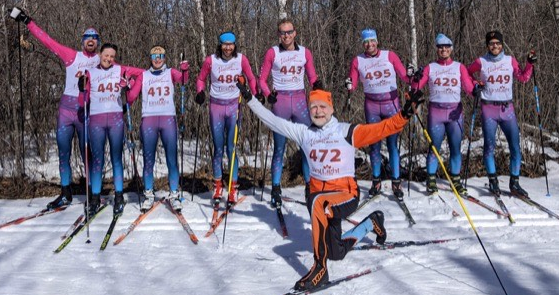
Vakava Team Photo

Vakava Team Photo
Vakava Racers at the Mora Last Chance Race

Monday, February 7, 2022

Mid-January Blues, Frostbite, and the City of Lakes Loppet Classic Race

Mid January Blues


The last three years, since Minneapolis hosted the Master’s World Cup, I’ve purposely not raced in January to sleep in and give myself a break prior to racing every weekend in February. Instead I’ve been doing hour-long L3 sessions by myself inside of three hour skis. This got tedious and so this year I was determined to do some January races. But not just any races, specifically I wanted to do races I’ve never done before. I signed up for one, the St. John’s Langlauf, but this became yet another casualty of COVID-19. 

Alex Reich from Vakava skiing fast in the Skate Loppet. Photo: Skinnyski

And so by mid-January the usual three negative themes emerged. My positive self-talk to remedy these situations are in italics.


1. I’m not prepared to race. This is ridiculous. I’ve trained for nine months. I’m at some of my highest training loads now, so of course I’m tired. I’m doing intervals and long skis and strength the same day- sometimes strength to exhaustion. I’ve trained at least as well, if not better, than every other year. I’m doing weekly intervals with Vakava and more intervals on my own. I’m ready to race.


2. I should have done more strength. I feel weak- especially the double pole. I had plans to do some double pole-only workouts. On the man-made loop at Wirth. Yeah, I know, it’s really hilly. But the snow has been slow. Really slow. Or is it just me? Well Elspeth, this is coming from someone who has done 100 pull-up days. I’ve likely done more weighted pull-ups than anyone who will be above me on the results page. It must be slow snow. It has been colder than usual. This is also where I glean motivation for more strength next year and when I usually think of better specific strength.


3. I don’t even like to race. I should quit. Oh, I battle this every year. I’ve learned some from running when I only do occasional races. I do better racing infrequently, thus every weekend in February is a bit daunting. So it’s important to remember why I race. To push myself, get out of my comfort zone. Because I actually like to go hard AND FAST. At least sometimes. COVID has also killed most of the social aspect of racing. No parties afterwards. So I need to take one race at a time. Think in the moment, approach each corner, uphill, flat, and straightaway as a novelty. As a chance to ski as fast as I can.

The best way to remedy these feelings is to race. There weren’t any nearby races the third weekend of January but the 4th weekend was packed. Erik and I debated between the William O-Brien Race and the Lumberjack Jaunt but ultimately decided against travel and waking up early. I pounded out one last solo interval session and then kicked off 5 weekends in a row of racing with the City of Lakes Loppet Classic Race the first weekend in February. 

Andy Schakel skiing to a good finish in the Skate Loppet. Photo: Skinnyski

Frostbite


I have cold hands. Most of the time this means the temp of my hands mimics their environment, even if my core is pleasantly warm. I’ve struggled with this and occasionally the screaming barfies my whole ski career. The tips of my pinky fingers are permanently numb.

This year I’ve decided to do something about it and purchased a huge pack of chemical hand warmers to use when it’s much below 10 degrees. The chemical warmers can be too hot next to my skin, so I’ve found that wearing nitrile gloves inside my mittens with the hand warmers is just right.

The problem is the poor thumbs. Usually after 10-15 minutes of skiing my thumbs will get warm with a mildly unpleasant tingling sensation and then they’ll be good but three nights before the City of Lakes Loppet, at Vakava practice with intervals, my left thumb just wasn’t warming up. I tried twice on long downhills, pulling my thumb in with my other fingers to rewarm it, but was unsuccessful. After that I gave up and finished the workout and only as I was cooling down did my thumb get warm- the screaming barfies, but because it was only one finger, it was mostly just screaming.

The thumb still felt funny though and it kept me up some of the night, throbbing. In all my years I’ve never frostbit any of my fingers this bad. My thumb swelled up. I thought it was going to blister but it didn’t. But this means I need to figure out how to not get it cold again which almost always happens if it’s below 10 degrees. And there’s plenty of that in the forecast. The obvious answer is to quit skiing. That would be easy. But I’m too stupid and stubborn. I’ll lose my thumb before I do that. Why hasn’t someone invented a chemical thumb warmer???

Erik proposed a number of solutions but finally we settled on taping handwarmers around my thumb on the outside of my mittens. 

Handwarmers taped to my thumbs on the outside. Back in business.

The City of Lakes Loppet


The Classic Loppet dawned cold, windy, and cloudy with temps forecasted to be 5 degrees warming to 13 with corresponding windchills of -12 to -2. It took me too many years to factor in the wind. I hate getting hot (some of this post was written in a 55 degree room in my house), so tend to dress on the cooler side. Despite years of ski racing, sometimes I’m a bit unsure of exactly what to wear. I figure that using hand and foot warmers, the parts of my body that are always coldest, allows me less layers under my spandex. In the end I wore a balaclava, hat, and two layers of long underwear under my spandex.

I arrived to the start glad to have the extra layers as the southeast wind kicked up across Bde Maka Ska. From my brief warm-up on skis, I learned it was faster outside the classic tracks due to drifted snow. I put my skis down in what looked like the second row. Despite them being 15 years old, no one put their skis in front of mine so I was on the front row! Erik, who started 45 minutes after me in the 20 km race, was there to take my warm-ups. I should’ve given myself more time as I struggled getting my pole straps on with the extra thumb handwarmers. With 10 seconds to go I didn’t have my straps on yet so moved to the side, knowing that at least it was faster out of the tracks.

Fortunately I got my straps on just as they said go and I was off double poling hard outside the tracks. I was able to tuck in behind my teammate Laura and another woman. On the west side of Bde Maka Ska the pace seemed to slow so I jumped in front to take the lead. Once we got to the protected south side of the lake we got in the classic tracks and I followed behind Laura. Just before going through the channel into Lake of the Isles, Margie passed me along with another woman. One more woman passed me as we got onto Lake of the Isles. I tried to ski with that pack and was able to until we got to the south side of Cedar when they bridged a gap on me I just couldn’t make up. Back in the day, when I had just started marathon racing in college, I always thought it would be so fun to ski with the lead pack of women but now I know it’s just a lot of work! 

Myself and Laura at the start of the Classic Loppet.

The Loppet did a good job of making a snow ribbon in the channels but coming off Cedar Lake onto the east beach was rough. At one point all the skiers just went off the trail onto nicer snow. The bare rock was exposed along the east trail (I’ve previously had good intentions of removing that rock but it is HUGE and beyond my ability without some heavy equipment. One guy who had just passed me was going a bit slow in this section and I put in a bit of an effort and got back in front of him and never saw him again. 

Vakava teammate Brock on course during the classic.

From this point on I just seemed to lose my top gear. I was still moving but struggled to ski some transition sections fast (finding dirt-free snow and intermittent classic tracks didn’t help) and couldn’t push the uphills. A handful of guys would pass me the remainder of the race and one woman in Butler. Fortunately my kick was decent which definitely helped. I also noted that while not always skiing the transitions terribly well, at least I wasn’t wobbling on my skis even when tired. My agility on skis has definitely improved. Like I’ve been saying about just about everything in life recently from wearing masks to speed records on downhills…practice!

On Skyline the tracks were windblown again and I mostly skied outside of the tracks. I was glad for the double layers under my spandex. I kept trying to push the double pole but didn’t feel uber strong. I enjoyed the more rolling parts of the course on Twin Lakes and then pushed up to Coach’s Corner. I kicked up in the tracks, noted that even though I wasn’t breathing super hard, I felt tired. 

Crossing over Wirth Parkway in North Wirth during the Loppet. Photo: Skinnyski

I completely missed the corner heading off the north finger. Under cloudy skies it wasn’t super obvious, I didn’t see the left V-boards, and likely the marshal wasn’t in an optimal position. It sucked losing all my speed on that hill but I guess so is life. Those last couple grinders- coming off the North Finger and up from La Squadra were mentally challenging to keep pushing and not just walk. I did do a tad of that in the steepest sections. The wind was so strong I double poled into La Squadra and then despite tucking, had to start poling again before I even got to the corner. I started double poling up the bottom of La Squadra and noted that my arms weren’t that tired so clearly I could have pushed harder but also makes me feel better heading into the Mora Classic next week- especially given they just lengthened the course! Even my double pole finish felt lackluster although there wasn’t anyone around me so there wasn’t too much point in sprinting.

In the end I was 6/40 women and 49/193 overall. Not too shabby. Laura rocked it and placed onto the podium in 3rd. In the men’s race Brock took 23rd overall.

Meanwhile, to mix things up, Erik decided to add some competition to the 20 km and won! 

Erik on his way to victory! Photo: Skinnyski

In Sunday’s skate race Vakava also had some great performances with Alex Reich 6th, Andy Schakel 9th, Craig Cardinal 12th, Jojo Baldus 14th, Brock Lundberg (after racing the previous day) 65th, and Hans Harlane 105th in the men’s race. Laura Cattaneo was the sole Vakava female in the women’s field and came up just shy of the podium with a 4th place but did win the overall Loppet Challenge. 

Jojo hammering the Skate Loppet. Photo: Skinnyski


Craig crushing it at the Skate Loppet. Photo: Skinnyski

Friday, January 7, 2022

December Vakava Racing

Despite only having two Vakava on-snow practices leading up to the New Year (due to lack of natural snow, warm weather that stalled snow-making, and one crazy thunderstorm) several Vakava members raced in Skadi’s Chase, the Hoigaards Relays, and the Winter Warm Up- all at Elm Creek.

At Skadi’s Chase on December 11th, Artie Huber led the way, finishing 7th in a field of 39. Dave Christopherson finished in 19th and was the oldest male competitor by 19 years. Cheryl DuBois was the lone Vakava woman racing, skiing to 7th place among the field of 21 women with most of those topping her less than half her age! 

Dave sporting an old Vakava Racing Suit.


Cheryl, center, wearing the hot pink Vakava hat.


Dave reports about December: “A rather slow start to the new season (after not much of a racing season at all last year), with only one race so far -- Skadi's Chase. The first one always hurts; serves as a good reminder of what racing really is. A small race, soft conditions, and didn't go particularly fast, but a start nevertheless.”

Vakava had a strong showing at the Hoigaard’s Relays on December 18th where teams raced 6 x 1.3 km loops Olympic-style in a skate race. With an inch of fresh snow, conditions were exactly as I like- firm underneath but soft on top. In the most competitive Masters Men division, Andy Schakel paired with non-Vakava skier Dave Benson to take 8th among 19 teams while Artie Huber raced with his son, a senior in high school, to take 11th. 

Andy tags his partner.


Cheryl DuBois and MaryBeth Tuttle teamed up as Vakava Hot Mamas to take 4th in the Masters Women category (but unofficially won best team name) as Maria Schilling partnered with non-Vakava member Kira Stolen to take 6th. Meanwhile, Bonnie and MaryBeth’s daughters, Emma Albrect and Libby Tuttle, took 3rd place. Regarding her race, Maria says “It was so much fun to pair with Kira Stolen, who I paddle with, for a different sport!:) Lots of amazing women's teams, too.”

Maria demonstrating some good weight transfer.


In the Masters Mixed, Brock Lundberg and Bonnie Wieskopf got 2nd while the married duo of Erik Pieh and myself, Elspeth Ronnander, took 3rd (although I question result accuracy and think we actually got 4th). We were hoping to be the first married couple across the line, but the Gregg’s took that honor so we settled for not getting lapped! I went hard the first lap- really hard- and then struggled to maintain that pace for the next two legs.

Me not too far behind Bonnie.


The result times weren’t terribly accurate. The teams of Bonnie and Brock, myself and Erik, and Artie and his son all finished within about a minute of each other, adding to some fun inter-squad competition. 

Erik, Emma Albrecht, Cheryl, and Brock (blocked by a guy in front of him) at the start.


Exchange zone craziness including 3 Vakava teams.

Photo evidence of team #43 finishing first.


Finally, in the Winter Warm Up 10 km skate (4 laps of the machine-made loop) on December 26th, Andy Schakel and Brock Lundberg took 4th and 10th place respectively. Artie Huber finished an uncharacteristic 34th- “I fell twice on downhills and after that I thought about quitting but decided to just tour the race,” he says.


From left to right- Andy, Artie, and Brock competing at the Winter Warm Up


A huge THANK YOU to Elm Creek for hosting all 3 races and to Three Rivers Park District, Hoigaards, and Pioneer Midwest for sponsoring the events. Bonnie adds “I would like to thank all the race volunteers, those not profiting monetarily from their efforts. They are such an inspiration and positive influence on their community.”

Saturday, December 4, 2021

Training Analysis Part Four: What Can Garmin Connect Tell Me?

After an almost two year hiatus (turns out publishing a book got in the way), I’m back with more analysis from my training log. This time, I’m going to see what the Garmin Connect website can do, pulling from years of my data going back to 2011. Note, I don’t always use my Garmin, especially for easy biking and running to and from work. Otherwise I use it for most workouts and all races.

I’ve had the Garmin 220 since late 2015 and prior to that the Garmin 210 that Erik got me for Christmas in 2010.

I should also establish that the principle three questions in analyzing my training log data are (1) what training makes me ski/run faster? (2) what training makes me ski/run slower? (3) what training is neutral?

It took me a tad to search through the left sidebar of the Garmin Connect website to find meaningful data, but then I happened on the “Reports” tab. On the “Reports” page, on the left side under “Reports” there’s a bunch of things to click on that are then displayed on a graph on the right. The graph on the right can then be changed to "7 days," "4 weeks," "6 months," or "1 year."


This graph shows my average heart rate per activity from January 26, 2020 to February 22, 2020. The high points correspond to the City of Lakes Loppet Classic Marathon, City of Lakes Loppet Skate Marathon, Mora Vasaloppet 42 km Classic, Minnesota Finlandia 25 km Classic, and Birkie 50 km Skate.


From here under “All Activities” I found “Total Activity Time” and “Total Distance” that generated some nice bar graphs representing my different activities for the year. 


This bar graph shows my total activity time in 2015, when I ran the Twin Cities Marathon. "Other" is mostly rollerskiing. This year we did a Thanksgiving ski trip to Colorado.

 
Here's my total activity time from this year when I didn't run a marathon.

 
For comparison to total time, this was my total distance in 2015. My August is lower because both year (2015 and 2021) I went on a backpacking trip and did not use my Garmin.

 
And 2021 total distance where I did a lot of rollerskiing in October!


Moving farther down the Reports on the left, if I clicked “Running” it opened up a new drop down menu that told me information about just my running workouts such as “Average Heart Rate” and “Total Distance.”


This graph shows my average heart rate for running only activities in September of this year with the one high value being the City of Lakes Half Marathon.


At the bottom of the “Reports” menu is “Progress Summary.” Clicking on this opens up a new page where I got most of my data. The first view that pops up tells me the number of all my recorded activities, distance, and time spent doing them. It was definitely a bit mind boggling to learned I’d entered almost 25,000 miles of human powered activities into Garmin Connect! Still, this info wasn’t terribly helpful so I kept searching through the different drop down menu options. I most liked to “Group by Year” under the “Progress Summary” option and then pick my activity. Doing this I generated a bunch of data. Note, the fields displayed can be customized on the right side. It’s also possible to customize dates. 


This is the default page that opens for the "Progress Summary." If you've never been here, it will likely blow your mind if you have much data. At the time I took this snip, I'd entered 2200 activities for over 24,000 miles in 3,687 hours climbing over a million feet of elevation gain! Quite the "wow" factor. Not terribly useful data other than something to remember on Bitch Hill.


Grouping by year, this shows the above data broken down annually.

 
Here's running by year.

 
Rollerskiing by year. Again, wow, over 6,500 miles of rollerskiing!

 
Classic skiing by year.

 
And skate skiing by year.

The only other useful left menu option I found is the “Activities.” By going to this tab and loading all my activities, I can quickly check average heart rates for races by searching for specific activity and under "Advanced Settings" choosing “Race” then “Filter Activities.” 

Here I've filtered to find just my skate ski races.


The best I could get for looking at my intensity or interval training is at the bottom of each specific activity where there’s a tab on the left for “Time in Zones” (this is next to “Stats” and “Laps”) which can show me my time in the different training zones for that specific workout only. There is no way in Garmin that I, or Erik, could find to analyze the intensity/interval training across different workouts or years. 

Heart rate zones for a recent L4 (5 x 3 minutes) classic ski interval workout I did at ABR that also included a couple hours of easy skiing.


It turns out I’m a bit of a data geek- not surprising given I always liked math. There was something about analyzing this data that was addicting. Even if I didn’t arrive at any great conclusions, the point of this exercise was to explore the Garmin Connect website and see what I could find.

But what I’m really looking for is to compare my time spent doing intervals and heart rates with race results. I should clarify that the most useful information I could get from Garmin Connect would tell me how to ideally train for my best race possible. Unfortunately the system just isn’t set up to compute this data.

Erik tells me I’d have to export my data to Strava, Runalyze, or TrainingPeaks and since that’s beyond the scope of this post, stay tuned!

Sunday, October 17, 2021

City of Lakes Half Marathon

Back in June, Erik declared he needed a race to provide some motivation. After debating some adventure and trail running races, we settled on the City of Lakes Half Marathon, which I argued could provide more specific goals than the unknowns that come with trail. 

Despite running the Loppet Trail Half Marathon a few times, a 26 km race around Lake Bemidji, and two marathons, this would be my first road half marathon. My pace for the 26 km race had been 7:56, so naturally I wanted to go for 7:50 for the half; however, that 26 km race may have been my best distance race ever and it was four years ago. After doing a couple threshold runs, 7:50 pace seemed too ambitious. Maybe a couple years of injuries and not doing much fast running has made me slow. I had some hopes that a week at altitude and Level 4 uphill running intervals would give me a boost but not so much luck. 

Finally the week before the half I did a new workout that I made up: 3 minutes and 30 seconds at 8:00 mile pace followed by 30 seconds of recovery jogging for an hour (15 reps total). The first 10 of these felt amazing, then #11 I increased my pace accidentally and the second half was uphill and by the end I was in Level 4. When I started #12 I was a bit dizzy but finished, possibly because then I was running downhill. #13 was another uphill and by half way through I was 2:1 breathing and my body was doing the thing where I feel like I needed to have explosive diarrhea (i.e. I was hitting my max). I stopped and walked, then rallied for numbers 14 and 15, hitting both at just under 8:00 pace. 

My heart rate for the 3:30 on 30 seconds off until I hit the wall (excuse the artifact at the beginning that always happens with my arm strap).

Looking back at my splits, I hit the wall after a few too many sub 8:00 paces in a row, so that told me I better aim higher than that for the marathon and decided to even go a bit conservative with 8:20 pace and then hopefully pick it up near the end. 

Race morning dawned moderate temp for September, cloudy, and maybe a touch humid (i.e. 60 degrees). The course, almost two laps around Lake Harriet and Bde Maka Ska, initially seemed a bit boring to me, but then I realized it doesn’t really matter much where I race and sometimes loops are nice. Erik’s training hadn’t gone particularly well after he got “dysentery” on our backpacking trip last month, and he was hoping to not get wified which meant he mostly planned to run with me. 

The race definitely has a large field. It felt a bit unnerving given the recent surge in COVID-19 cases. I kept a mask on in the port-a-potty line and for awhile in the starting gate. Erik and I started relatively near the front but not too close. When the gun went off it was a bit of a traffic jam. Just chill, Elspeth. We’re probably going faster than I think. And every second I run slower now are seconds faster I will run later. 

Less than a half mile into the course it climbs a hill on the south side of Lake Harriet. This was good to string out the runners. As we made our way along the east side of Lake Harried the course was fairly packed.There was plenty of room for people to pass, but there were a good number of people around me. I tried to keep things in control and not go with anyone passing me. My splits were mostly on target. It was still easy. 

City of Lakes Half Marathon course per my Garmin. Note the start (green arrow) at Baird's Plaisance is not where it finishes (red square) at the Lake Harriet Bandshell- so it's not quite two loops.

I ran a bit fast up the hill between Lake Harriet and Bde Maka Ska but then reeled things in. There was another hill on the east side of Bde Maka Ska that I didn’t know about. We ran in a lane on Lake Street on the north side of Bde Maka Ska. A woman passed me wearing a tie-die t-shirt with wolves on it. I wondered if it was cotton. It wasn’t exactly form fitting but despite her shirt, this woman was cruising! It reminded me of a guy who had passed me early on wearing a singlet with a tree pattern- probably the prettiest singlet I’ve ever seen. It’s interesting how people wear different clothing and it doesn’t always match their speed. 

We got cross wind on the southwest side of Bde Maka Ska that became a headwind as we turned east. I ducked behind a couple guys to draft off them. It’s not something I usually do running but it worked. As we turned to go back towards Lake Harriet there was a two-way section and Erik and I were both a bit stunned by the fastest runners who were already heading back to Bde Maka Ska. Soon we were through the lap/finish and going back around Lake Harriet. 

As we climbed the hill on the south side of Lake Harriet I tried to keep things in check but couldn’t help noting the women in front of me that seemed to be slowing. Let’s race. It’s time to catch the women, I thought at mile 8. By now I was starting to breathe a little harder. I still felt good, but there were also still 5 miles left. I passed a couple of women and then we were back on the two-way section. The top runners were lapping a lot of runners. The woman I had been running with for the past couple miles pulled ahead of me along with another guy. I took a gel at the top of the hill on the east side of Bde Maka Ska, arguably as Erik would later say, a bit late in the race. 

Then we were down the hill, back on to the closed lane of Lake Street, going up the rise over the canal, then flat, zoning in on mile 11. My plan here had been to speed up if I felt good but I knew I was already running under pace and only had at max two sub-8 minute miles in me. All I could do was maintain. 

I came through mile 11. Let’s go hunting. Not many women in my sights though- not many men either. Everyone was really spread out. I didn’t feel like pushing much faster. I was working hard and the next mile flew by. One mile left. By now I was closing in on two women. It seemed it was taking forever to pass them. Erik moved in front of me. I stuck on him. Slowly we passed the women. The wind wasn’t as strong this lap around Bde Maka Ska. 

The last half mile droned on forever. I resisted the urge to look at my watch to see the tenths of a mile pass by. We turned onto the two-way between the lakes. I moved alongside Erik. Slower runners were coming in the opposite direction. I pushed hard up the hill. Erik and I were tied. There was a brief plateau, then more climbing. Elspeth, remember how you feel now, I’m giving this all I can. Then we were over the hump, made a sharp right turn, then gradual downhill to the finish. I pushed what I could and Erik and I crossed the finish line together. 

After finishing we walked towards the food tent. I got the chills and the feeling that I had to poop. It was brief but meant I’d finished hard. 

My time was 1:47:12 for 8:12 mile pace which was about the best I thought I could do based on my training. Obviously not the 7:50 pace I was initially hoping for, but still decent for me. I know I have a higher gear, but it didn’t come out to play and that’s OK. My average heart rate was 152 with a max of 167. And I finished 70th of 357 women! 

My nice heart rate graph, slowly increasing, for the half marathon.

For now I’ll go back to the ski training but next year I’ll set my sights on some more running and hopefully no injuries. 

Aside from the half marathon, my training this year has been woefully inadequate. Most weeks I’ve been averaging just under 12 hours, the amount I consider my baseline. After a backpacking trip in Yosemite at the end of September, I’m determined to average at least 12 hours/week of training for October and November, if not even more. My long Sunday rollerskis all need to be at least 2.5 hours. Time to start hill bounding!